When Power moves Faster than Institutions: The case of The Indonesian “Big Bang” Decentralization
When Autonomy and Capacity Diverge
In 1998, Indonesia’s Reformasi movement offered hope of a new era. Demands from civil society had been directly targeted at replacing the former government. The reform finally forced the unthinkable: Soeharto’s resignation from the presidency, finalizing the chapter of the New Order in Indonesian history.
Reformasi was expected to be a turning point for Indonesian democracy. Law Number 22 of 1999 on Regional Government and Law Number 25 of 1999 on Fiscal Balance between Central and Regional Governments became significant milestones, effectively laying the foundation for the independence of subnational governments in domestic political affairs. For a moment, the pillars of change seemed established, and the promise of a new Indonesia seemed to be within reach.
Twenty-seven years have passed since, yet the dream of a new Indonesia still feels long overdue. Stalled by institutional failures, the steady erosion of democratic principles, and overly concentrated power structures, Indonesia has failed to deliver on its promise of equitable development. And the very heart of it, decentralization, becomes a subject of paradoxical scrutiny.

The 2001 Decentralization, or “The Big Bang Decentralization”, was enacted to redistribute the political, fiscal, and administrative capacity to local agents. It was legally anchored on Law Number 22 of 1999 and Law Number 25 of 1999, effectively increasing the autonomy for municipalities and city-level governments. Although theoretically aligned with Oates’ (1972) framework, it is conditional on the existence of a robust and democratic local institution.
Evidently, the post-decentralization consequences of Reformasi have produced mixed socio-economic results. Several indicators have highlighted alarming economic conditions, as evidenced by a steady increase in the Gini Index. In addition, Freedom House’s score has also indicated a steady erosion of democratic quality in Indonesia, plateauing in the late 2000s.

Several pieces of evidence have also highlighted the nuanced results of the post-decentralization period. Although granted higher authority to obtain local revenues, changes in the proportion of locally sourced revenue (PAD) in respect to central transfer remain dormant for most local governments. Furthermore, the widening of corruption distribution by elected officials also signals institutional failure, producing a flawed check-and-balance procedure that was once thought to be superior in a decentralized system.
With the creation of a profound legal basis and an apparent shift towards the democratization of Indonesia’s political culture, we then ask: what went wrong? Have the institutional and social conditionalities for the Indonesian landscape yet been met for an effective decentralization? Are we moving too fast, too soon?
Historically, Indonesia is not the only one experiencing a disappointing turn. Numerous decentralizing nations, particularly in Asia and Latin America, also encountered mixed results. Using cases from the Philippines and Pakistan, Guess (2005) highlights that the implementation problem by supervisory institutions often determines the success of decentralization. He specifies aspects that include fiscal and political support, individual capacity of policymakers, modification of cultural constraints, and the strength of institutions as determining factors of regional decentralization’s effectiveness.
Malesky and Hutchinson (2016) emphasize that the deficiency in implementing decentralization is caused by the resistance of authoritarian elites, who fear losing control. Using examples from Cambodia, Myanmar, Thailand, and Vietnam, they highlighted that the ability to choose the local government as a training ground is highly dependent on the central government’s political will. Thus, authoritarian governments will attempt to restrict such educational initiatives.
The study from Faguet and Shami (2022) illustrates a contrasting comparison between two decentralizing nations, with Bolivia decentralizing under a democracy and Pakistan under an authoritarian regime. Both were differently designed and had different outcomes, highlighting the cultural and institutional conditionalities of decentralization.
In Bolivia, decentralization was initially enacted as a response to the decline of the MNR (Movimiento Nacionalista Revolucionario), providing an opportunity for the then-government to gain loyalty from Bolivia’s rural voters. In addition, decentralization also offers a response to the regional pressures that demanded a greater fiscal and political autonomy from La Paz. The Bolivian decentralization was enacted with several mechanisms, including the enforcement of ownership of infrastructure and responsibility for the provision of primary services by local governments, twenty percent transfer of national tax revenues to municipalities, allocation of funds to municipalities on a strict per capita basis, creation of Oversight Committees to enhance accountability by civic organizations, the creation of new municipalities, and expansion of existing municipalities. The result was immediate and significant, dramatically shifting resource allocation to the smaller municipalities. Bolivian subnational governments increased their responsiveness to local needs, and decentralization became a lasting national characteristic.
On the other hand, Pakistan’s decentralization was designed to increase the legitimacy of Musharraf’s leadership by initiating the creation of new local governments and extending some existing services. By overthrowing an elected government, Musharraf’s decentralization prioritized the exclusion of the existing political establishment. The proposed mechanism lacked the institutional enforcement necessary for an effective decentralization, resulting in an architectural system characterised by poor service responsibilities and reporting, along with an ambiguous procedure of fiscal flows. The decentralization gained little support from the Pakistani grass-roots and significant opposition from existing political parties. In effect, Musharraf’s decentralized system only lasted for 7 years before being abolished in 2008, along with his resignation.
For Indonesia, the mechanism of decentralization is built upon the pillars of political, administrative, and fiscal aspects, uniformly applied to all subnational regions. Firstly, decentralization forces a delegation of authority to local governments through local elections for subnational government heads and the Regional House of Representatives (DPRD) at the district level. Secondly, the authority on the provision of most local public services is transferred from central to subnational governments. Lastly, local governments gained increased authority for managing expenditures and are encouraged to collect local taxes through the mechanism of regionally owned revenue (PAD).
Prior to decentralization, Indonesian districts function under the strict control of the central government. Under the framework of Law No. 5 of 1974, regional governments were predominantly reliant on the central government. Mostly, revenue sources are obtained from the Subsidy Fund (SDO) and Instruction Funds (Dana Instruksi), with minimal revenue sharing from natural resources. Thus, the 1999 laws replaced the former model of dependency with an entirely new framework for self-governance and independence.
Apparently, the uniform approach to Indonesian decentralization, although equitable in spirit, has failed to consider the asymmetrical economic and social landscape of affected districts. With significant disparities in fiscal capacity, public infrastructure, and human resources quality, Indonesian decentralization rested on the conceptual axiom that greater autonomy, regardless of institutional readiness, would produce positive social and economic consequences for treated districts. An increasingly contested idea based on recent evidence.
By such a mechanism, Indonesian decentralization has yet to take into account the unique adaptability of regions. The implementation rests on the assumption that greater independence allows districts to exercise control over resources, that independence and autonomy should be an unambiguous strength and a driving factor for better economic growth. However, such an approach undermines the importance of addressing different constraints of regional government.
Between 1996 to 1999, Indonesian districts are structurally unequal in several foundational aspects. Using the dataset obtained from the World Bank’s Indonesia Dataset for Economic and Policy Research, it is shown that the socio-economic conditions vary significantly. The result indicated that aspects such as regional human development index (HDI), fiscal capacity, physical infrastructure, and government service delivery, differ severely.
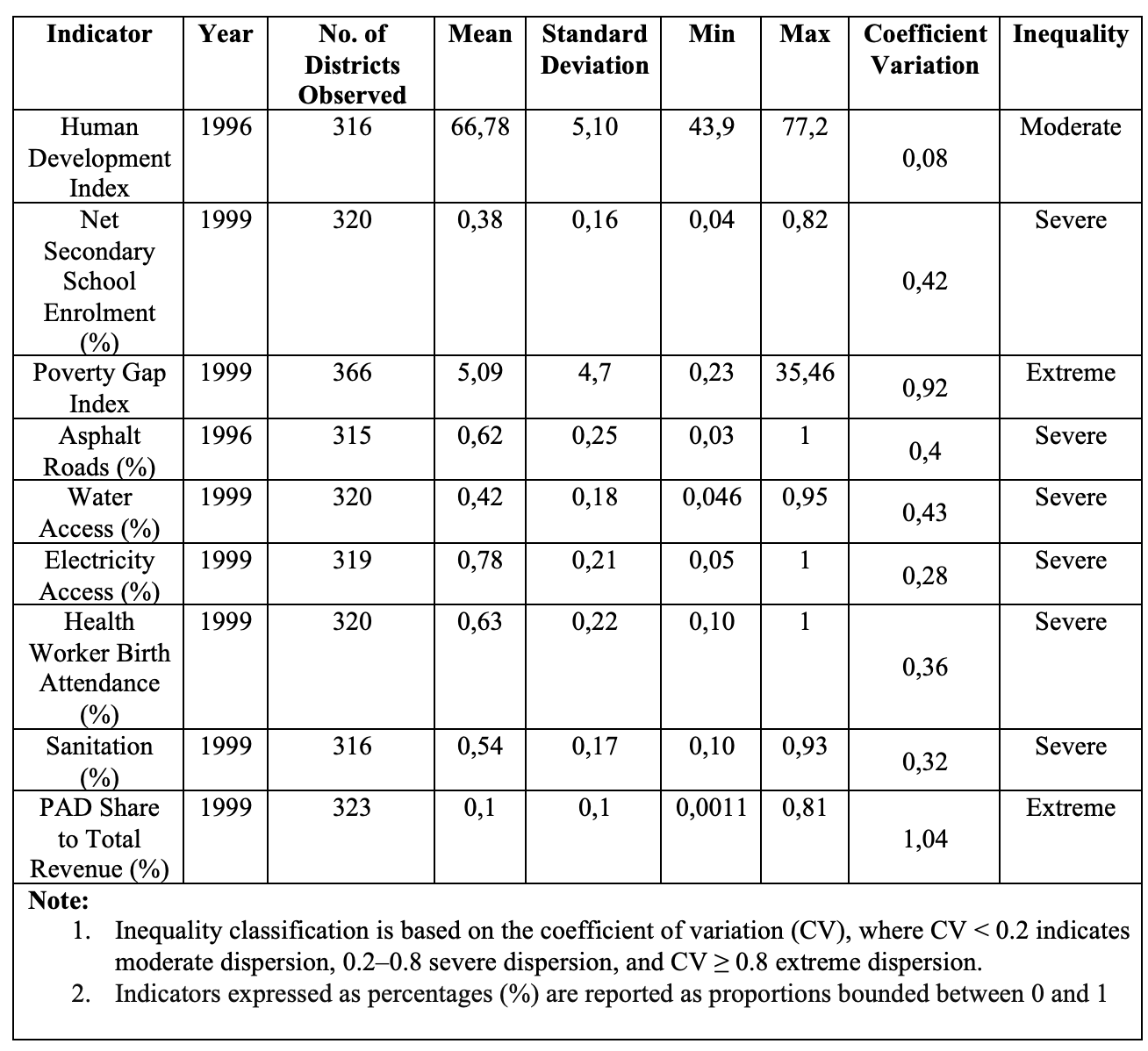
It highlighted the widespread inequality in areas such as regional economic conditions, fiscal capacity, and service delivery. Furthermore, it is indicated that although the human development index is moderately unequal, subnational advancement in aspects of human capital, as measured by the percentage of net secondary school enrolment, varies significantly among districts.
Not to mention, other measurements also indicated severe variation in the quality of provision of basic needs, which include access to electricity and sanitation. Moreover, health service indicators, as illustrated by the percentage of child births attended by health workers, showed significant inequality. With such a condition, it highlights the disparities in the local government’s ability to provide basic services, indicating evidence of unequal service delivery.
Other regional economic indicators also showcased similar results. Proxied by percentages of roads already covered with asphalt, the physical infrastructure of Indonesian districts was severely unequal prior to decentralization. This aspect is especially important for the Indonesian development agenda, underlining the existence of a structural barrier for equitable subnational economic activities.
Some indicators showed more staggering results. The poverty gap indicated a coefficient variation of more than 0.9, highlighting the existence of extreme inequality among regions. Furthermore, fiscal independence, proxied by the PAD share over total revenue, exceptionally reached over a 1-point value of the coefficient variation. These aspects revealed a foundational discovery for Indonesian districts prior to decentralization, that institutional capacity varies extremely amongst regions. Thus, their adaptability towards the uniform “Big Bang Decentralization” is highly influenced by these extraordinarily different prerequisites.
Based on such evidence, the Indonesian decentralization sparked an important perspective, one that highlights the potential dilemma of undertaking a uniform approach to distributing power. Particularly, the Indonesian case highlights the need to anticipate structural constraints. That is, one that takes into account the institutional adaptability of affected regions.
A simultaneous, uniform, and significant increase in fiscal resources and the local government’s authority may result in unintended consequences if implemented in a landscape characterised by severe inter-regional inequalities. One unambiguous premise following the 2001 power distribution is that local governments uniformly gained abundant opportunities but were strained by an evidently unique self-imposed limitation. However, for the Indonesian case, increasing central transfers or electing local government officials do not seem to tackle these limitations. Thus, it reveals such structural constraints that are possibly unaddressed.
By instituting the 2001 decentralization reform, Indonesia has created a framework for equitable power distribution. But, behind the legal hardware, lie such deeper complexities. One that is intangible and only seemingly permanent.
Indonesia did not decentralize into a neutral landscape. Rather, it unfolded across regions with severe administrative, fiscal, and service inequality. Yet, even though power can be distributed simultaneously among regions, capacity differs in character.
It is not that the decentralization is wrong, but it has revealed a foundational principle amongst Indonesian regions. The success of autonomy and independence is conditional. It may expose the fragility of some and accelerate the opportunity of others.
The lesson is that institutional sequencing matters. Power can be transferred, but not the institutional ability that comes with it. When power moves faster than institutions, the promise of empowerment may strain and risk the benefits of the transformation it brings. Two decades later, decentralization remains a discussion, and with it, its paradoxical manifestation.