


The middle class is the engine of growth. In Indonesia, the middle class contributes to 40% of national consumption, despite comprising less than 20% of the total population (CMCE, 2025). Their stable income levels support long-term investments in human capital, such as education and healthcare, while their spending stimulates private sector growth across diverse industries. A strong middle class is essential for political stability, fiscal strength, and accountable governance (OECD, 2019). Middle-class households not only drive consumption but also contribute to tax revenues, civic engagement, and institutional accountability. They tend to invest more in education and entrepreneurship, while simultaneously demanding better governance and public services.
Yet this critical demographic is shrinking. Since 2018, Indonesia’s middle class has contracted in every consecutive year (Figure 1). Over that period, the share of the population classified as middle class has fallen from 22.53% to 17.18% (BPS, 2024), a troubling reversal that has quietly undermined the foundations of Indonesia’s long-term development prospects. Central to this decline is a single, persistent problem: the disappearance of quality middle-class jobs. Jobs with decent pay and proper social security to provide a middle-class living, and thus drive a nation’s consumption (Wihardja & Cunningham, 2021). Without them, economic activity cannot sustain itself. Understanding why these jobs are disappearing requires a look back at what once created them.
Figure 1. Indonesia’s Shrinking Middle Class
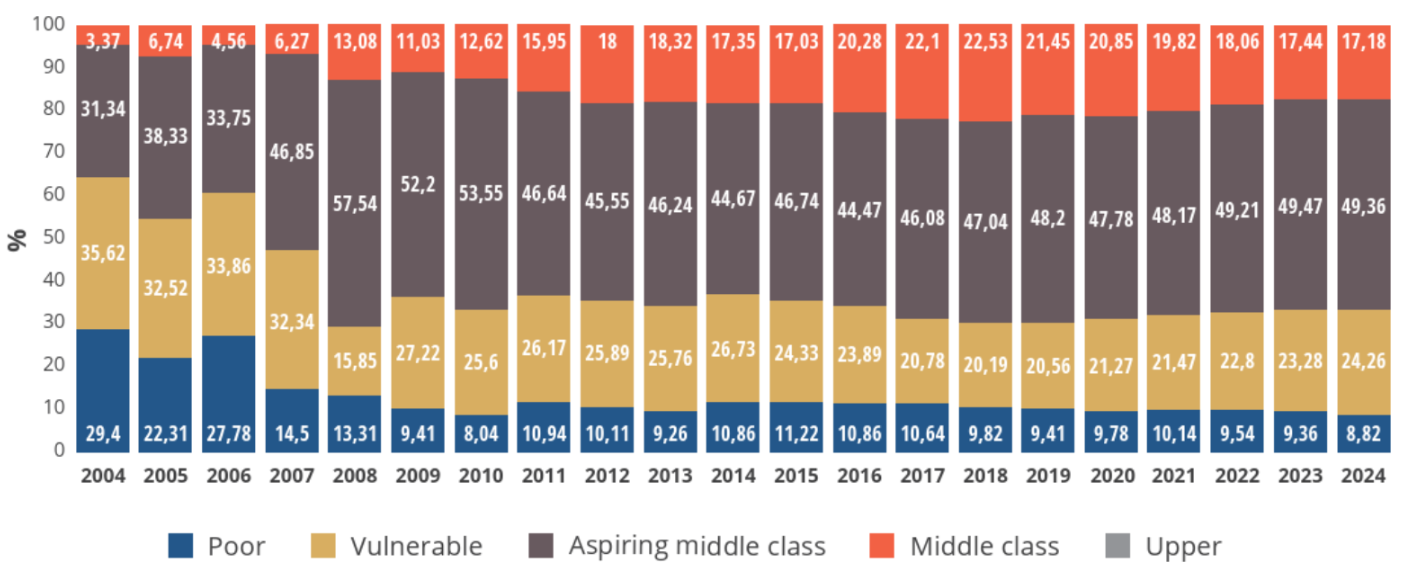
Source: Susenas, 2004 - 2024
It Wasn’t Always Like This: The Manufacturing Era
Manufacturing was once the great equalizer of the middle class. It generated middle-skilled jobs, roles that did not necessarily require high levels of formal education, yet paid wages sufficient to sustain a middle-class lifestyle. Families employed in manufacturing could afford their daily needs, save modestly, and participate in larger consumer markets: buying motorcycles, appliances, and perhaps even automobiles. This consumption, in turn, stimulated broader economic activity. The story was visible most clearly in post-World War II America, where rising demand for automobiles and strengthened labor regulations ushered in a generation of factory workers who formed the backbone of the American middle class (Piketty, 2012).
The same dynamic took hold in Indonesia. Manufacturing supported the nation’s middle class throughout the 1980s and 1990s, providing a pathway out of agricultural poverty for millions. But the 1997 Asian Financial Crisis (AFC) changed everything (Wihardja & Cunningham, 2021). Manufacturing never recovered to its pre-AFC levels. Instead, Indonesia turned toward commodities, palm oil, coal, and natural resources, as its primary engine of growth. This pivot offered short-term prosperity but a structural trap in the long run.
The commodity sector, unlike manufacturing, is not labor-intensive. It cannot provide the mass quality employment that factories once did. As Indonesia’s workforce continued to transition away from traditional agriculture, manufacturing jobs were no longer waiting to absorb them. The result was an exodus of workers into the only sector that would take them: low-productivity services.
The Service Trap: Not All Jobs Are Created Equal
Since the manufacturing and commodity sectors could not absorb the full breadth of Indonesia’s growing labor force, the service sector stepped in, but not in the way that policymakers had hoped. The jobs created were concentrated in wholesale and retail trade, accommodation, and food and beverages. As Figure 2 shows, most of these workers are informal: food vendors, street sellers, and ride-hailing drivers. While these jobs provide income, they are low-productivity, low-wage, and largely excluded from formal social security systems. They do not generate the kind of spending power that sustains a middle-class household.
Figure 2. Low-Productivity Services in Indonesia
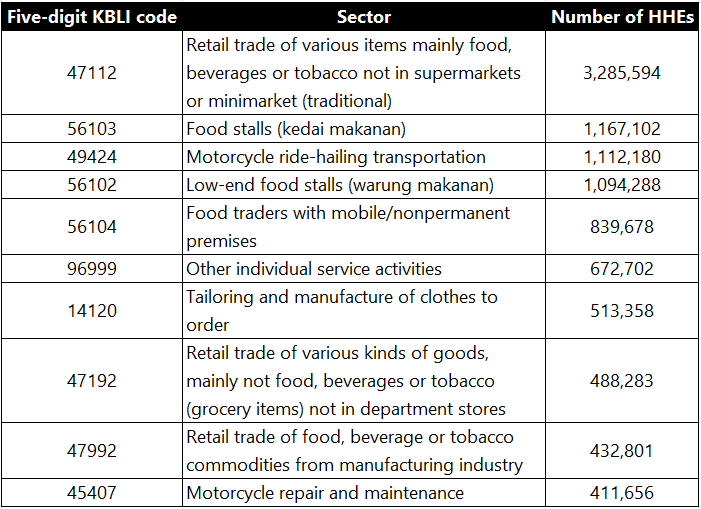
Source: Wihardja & Cunningham (2021)
The critical insight here is that services are not a homogenous category. They are deeply polarized. At one end of the spectrum are high-skill services such as information technology, finance, law, and professional consulting. These are tradeable services: they can be exported, attract foreign income, and generate significant productivity gains. At the other end are low-skill, demand-constrained services, which can only grow if domestic incomes rise and households spend locally (Nayyar & Davies, 2023). The problem is not that Indonesia has too many service workers, it is that most of them are concentrated in the wrong part of the spectrum.
High-skill services, while lucrative, relatively employ less workers. They require significant educational credentials and technical expertise that much of Indonesia’s labor force does not yet possess. This creates a polarized labor market: a small premium tier of well-paid knowledge workers, and a vast, informal base of low-wage service workers with little prospect for upward mobility. The middle — the stable, modestly skilled manufacturing jobs that once formed the bridge between poverty and middle-class life — has hollowed out.
Technology has compounded this challenge. As manufacturing evolved globally, it became increasingly automated. Manufacturers grew adept at minimizing labor costs through robotics and process optimization, reducing the number of workers needed per unit of output. This means that even if Indonesia were to successfully reindustrialize, the manufacturing sector of today is unlikely to absorb labor at the scale it did in the 1980s. The old playbook is no longer fully available.
Premature Deindustrialization and the Problem with a Service-Led Growth
Indonesia’s experience reflects a broader global phenomenon known as premature deindustrialization, the tendency of developing economies to shift away from manufacturing before they have fully reaped its productivity and employment benefits. Historically, countries industrialized, built a middle class through manufacturing employment, and then gradually transitioned to services as incomes and education levels rose. Indonesia, like many developing nations, appears to have skipped or truncated this middle phase.
As the economy has matured, Indonesia has continued to create more jobs in low-productivity services rather than in the high-productivity sectors that drive wage growth (Wihardja & Cunningham, 2021). This is the service-led growth paradox: the service sector expands, employment statistics improve, yet middle-class formation stagnates because the jobs being created do not pay enough to propel workers into stable, consumption-driven lifestyles.
This is not merely an economic failure, but also a social one. The shrinking middle class weakens institutional accountability, reduces civic participation, and narrows the tax base that funds public services. It is a self-reinforcing cycle: fewer middle-class jobs lead to lower consumption, which suppresses demand for the kinds of services and goods that would otherwise create more middle-class jobs.
Solutions to Creating Middle-class Jobs
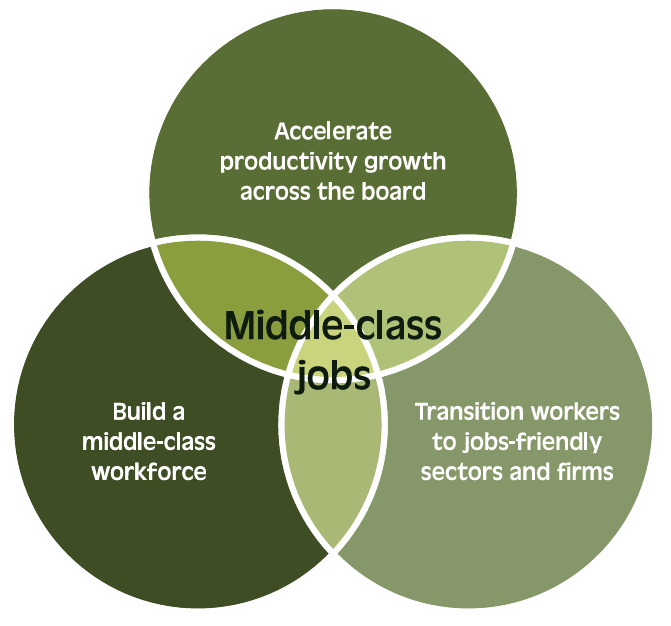
Reversing this trajectory requires action on three interlocking fronts (Wihardja & Cunningham, 2021). The first is accelerating productivity growth across the board. Indonesian firms in nearly every sector operate at low productivity levels, and the most effective lever for change is competition-enhancing policy — lowering trade costs, improving the business environment, and attracting foreign direct investment tied to global value chains. Alongside this, small, medium, and household enterprises, which employ the majority of Indonesians, need targeted support to grow their productivity and become better creators of middle-class jobs.
Figure 3. Three Long-Term Strategies to Create Middle Class Jobs
Source: Wihardja & Cunningham (2021)
The second pathway is transitioning workers toward jobs-friendly sectors and firms. Productivity gains alone will not automatically redirect labor toward where middle-class jobs are most likely to emerge. Indonesia needs deliberate investment promotion in modern manufacturing, ICT, health, and export-oriented services, paired with the infrastructure and regulatory environment to make those sectors attractive. Equally critical is closing the information gap: platforms like Karirhub, which consolidate job vacancies and training opportunities, help workers navigate toward better options, but these must be paired with transitional support such as unemployment insurance so that changing jobs is financially viable, not just aspirationally desirable.
The third pathway, and perhaps the most foundational, is building a workforce capable of filling higher-quality jobs. Today, 57 percent of Indonesia’s labor force has a lower-secondary education or less, and the country ranks last among comparable middle-income economies on standardized adult skill assessments (Wihardja & Cunningham, 2021). Preparing the next generation requires an education system with far greater emphasis on cognitive, interpersonal, and digital skills. But the more pressing challenge is the existing adult workforce, which will not return to school. This is where innovations in reskilling matter most: programs like Kartu Prakerja, which funds upskilling through online platforms, point in the right direction, though their scale must expand significantly. These three pathways are not sequential; they must be pursued together, because progress on any one of them depends on advances in the others.
Conclusion: A Coordinated Challenge
Indonesia’s middle-class decline is not the result of a single policy failure, it is the cumulative outcome of structural decisions made over decades: the shift away from manufacturing after the Asian Financial Crisis, the commodity dependence that followed, and the passive absorption of surplus labor into low-productivity services. Reversing it will require an equally structural response.
The three pathways identified are not quick fixes. They are the blueprint of a long-term agenda. What is clear is that the goal cannot simply be to create more jobs. Indonesia already creates millions of jobs each year. The problem is that most of them do not pay enough to sustain a middle-class life. The only path forward is to shift the quality, not just the quantity, of employment. Moving workers up the productivity ladder through deliberate, coordinated policy. Whether Indonesia can do so quickly enough, before its demographic window narrows further, is the defining economic question of the coming decade.