

Economics presents itself as a universal science, built on generalizable principles. Yet, economists rarely agree, and more importantly, not all ideas carry equal weight. As George Bernard Shaw once remarked, “If all the economists were laid end to end, they would not reach a conclusion.” But disagreement is not the only issue. The production and circulation of economic ideas are unevenly distributed, concentrated within certain groups of institutions and regions.
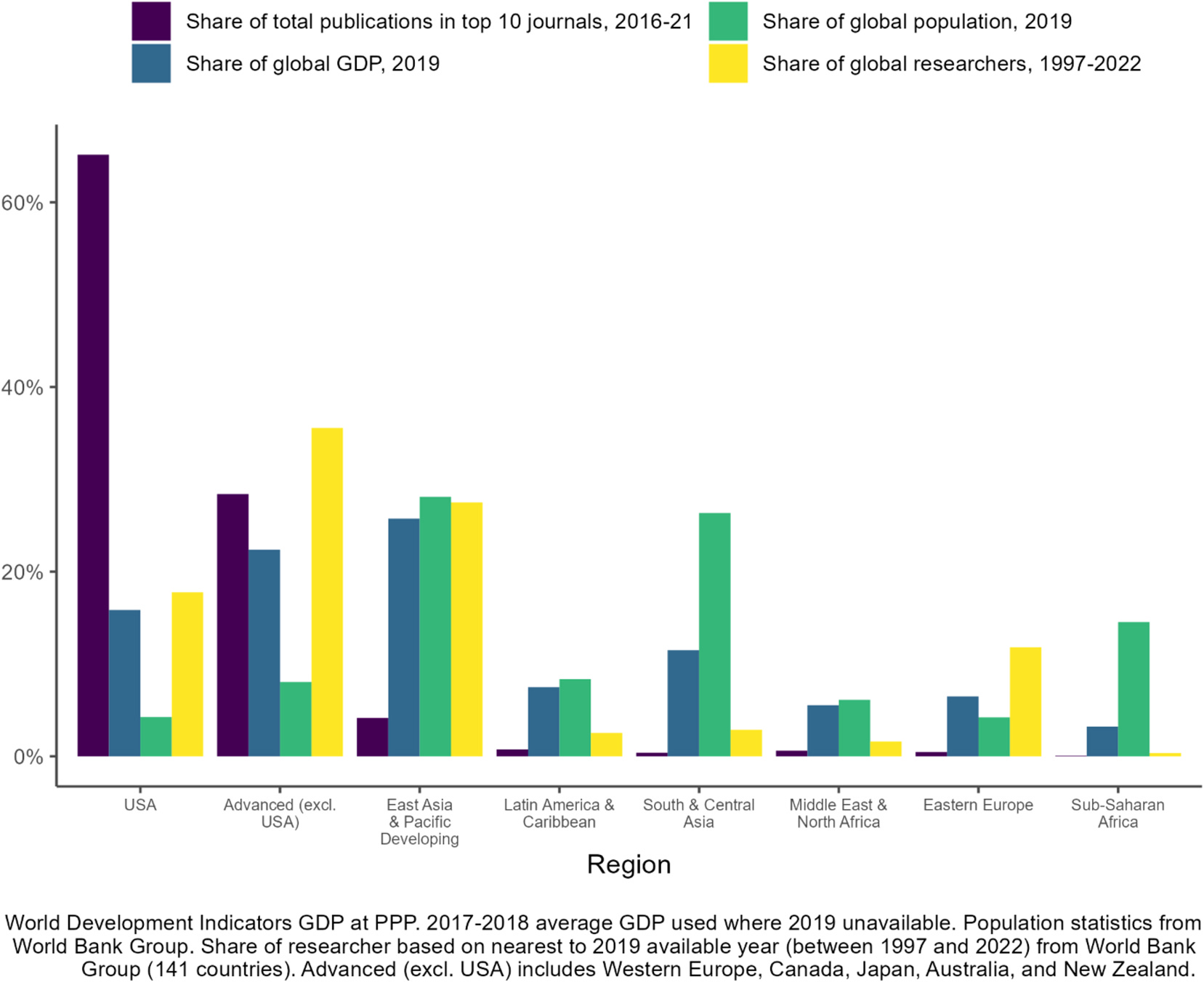
Aigner, Greenspon, and Rodrik (2025) provided strong evidence for the case of such unevenness. They highlighted that between 2016 and 2021, the share of total publications in the top 10 economics journals has been dominated by Western countries. The USA accounted for more than half of the total share of publications, while advanced countries, including Western Europe, Canada, Japan, Australia, and New Zealand, cover most of the remainder. Developing countries, including nations in East Asia & Pacific, which have a noticeably larger global GDP share than the USA and those of advanced countries, contributed less than 5% share. This showcases that the global distribution of authorship in economic journals has been severely unequal.
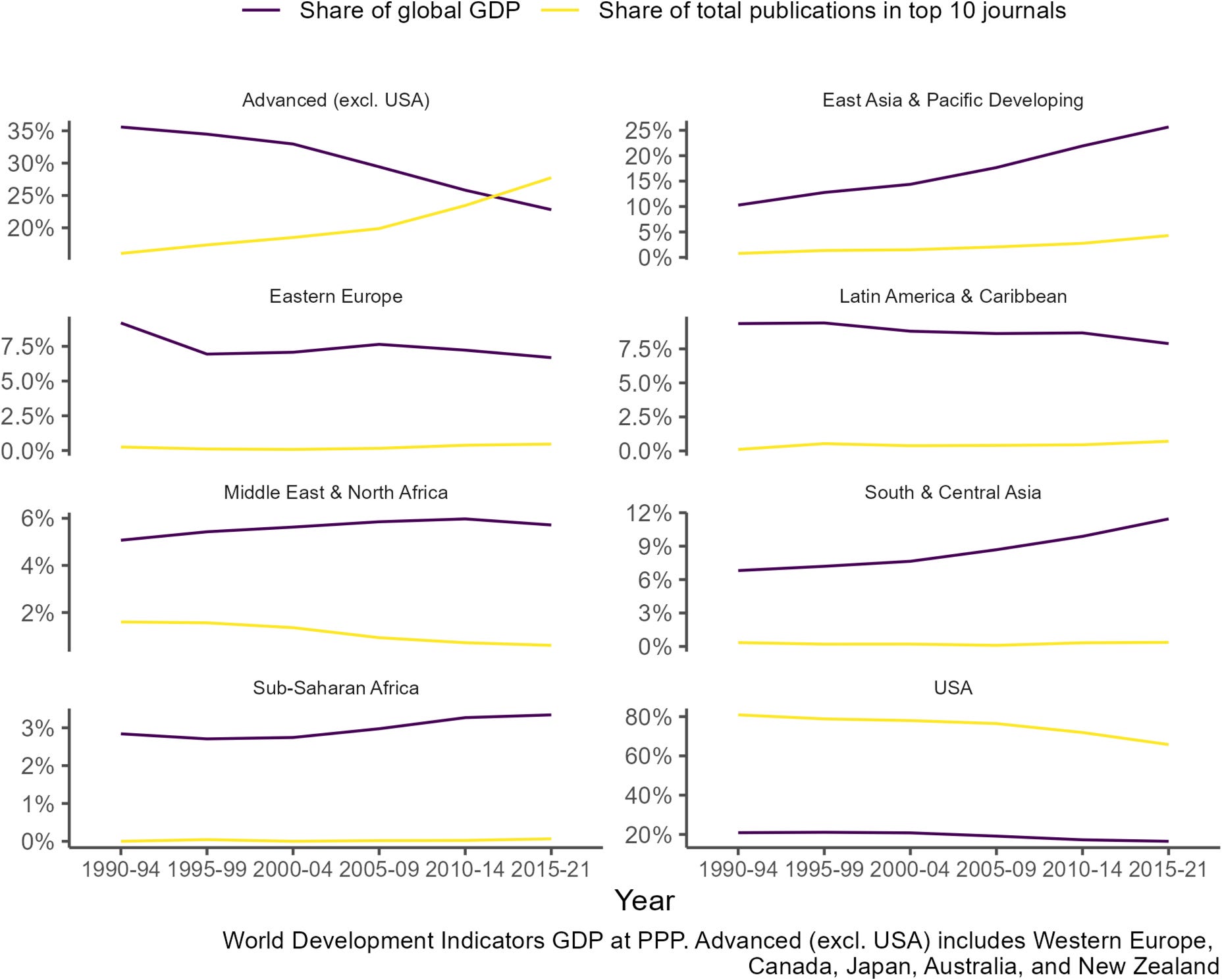
They also found that the inequality is persistent. Since 1990, changes in the share of authorships have been only slight. The USA lost about 20% of its share, but most of the shares were then replaced by contributions from advanced countries. Other regions gained little significance in advancement, despite most of it experiencing significant growth in GDP contribution.
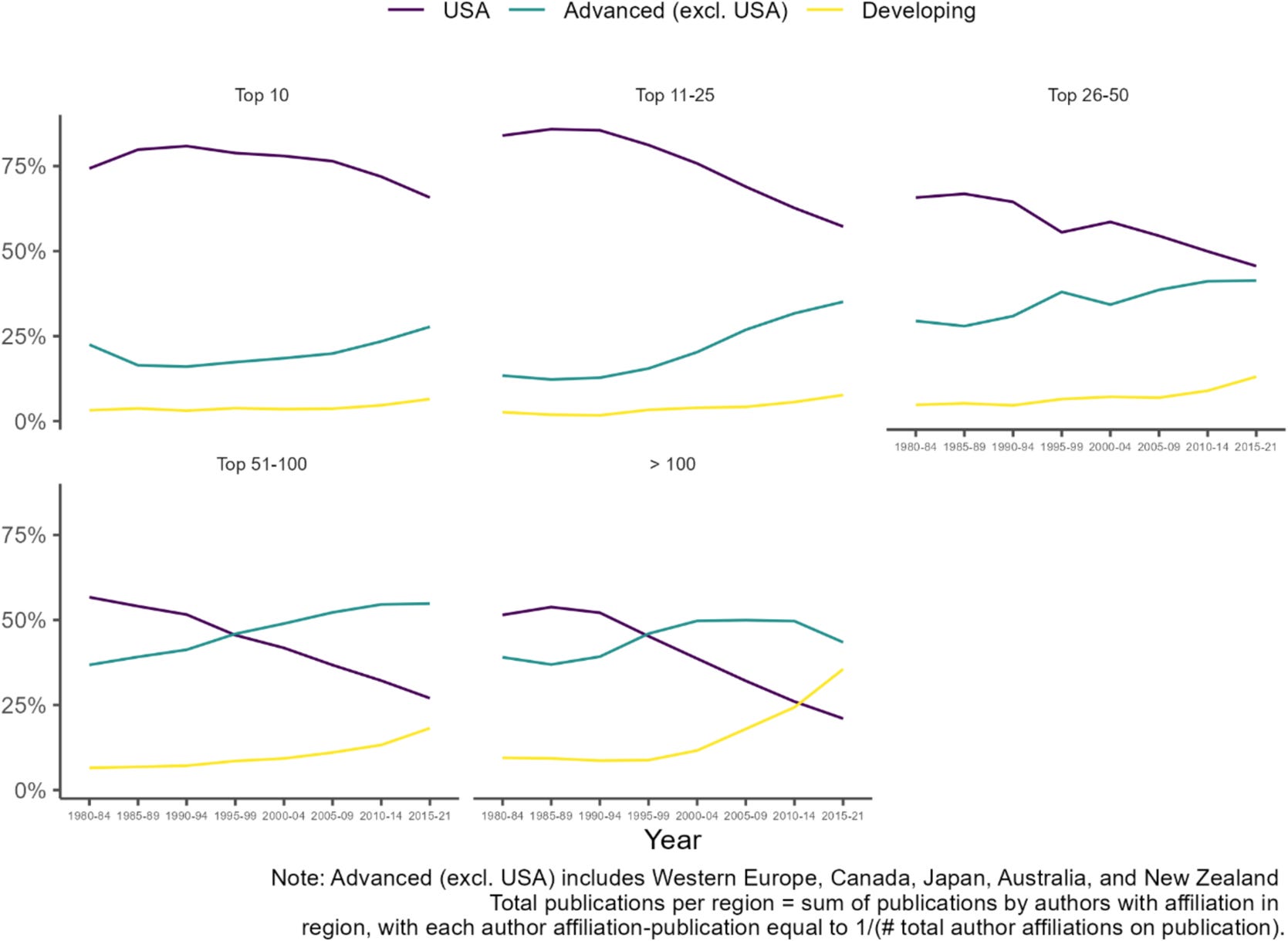
They found that a significant increase in the contribution of developing countries has been mainly attributed to lower-ranked journals. Again, the USA and the advanced countries remain dominant contributors to the top 100 economic journals. Thus, regardless of economic performance, hierarchy seems to persist in the field of economics.
This evidence underlines that some regions have greater influence in shaping the field than others. Representation is not just a matter of inclusion, but about power. If economics is a universal science, then power concentration is a structural problem. And with its universality contested, the question then is: “How universal is economics, and why?”
Maybe, the answer lies, in part, in how knowledge systems reproduce themselves. Hierarchies are often not purely meritocratic, they are also institutional. Prestige itself a byproduct of historical accumulation: trainings, networks, funds, and practices that reinforced visibility. The circumstances are not always intentional.
This matters because economics does not merely describe the world, it shapes it. When those assumptions are generated predominantly by scholars embedded in certain economies, they carry with them a particular reading of what economic problems look like and what solutions are available. The field’s knowledge is not neutral, it is positioned.
None of this is to say that economics has nothing universal to offer. Supply and demand, incentive structures, the logic of comparative advantage, these are not one-sided notions. But there is a difference between universal principles and universal assumptions.
The Aigner, Greenspon, and Rodrik findings should unsettle us not because some economists are wrong, but because an economics that is answerable to only one part of the world will eventually become answerable to no one. The problems of the twenty-first century will not be solved by inherited frameworks alone. They will require economists who carry different problems in their gut, different failures in their memory, different institutions in their baseline assumptions.
So: how universal is economics? In its ambitions, it aspires to be. In its current practice, it is not. The gap between the two is not merely an academic concern. Whose economy we study determines whose economy we understand. And whose economy we understand determines whose economy we build.