Indonesia’s productivity debate often begins with the usual suspects: investment, infrastructure, education, institutions, and technology. These are important. But they leave one mechanism underdeveloped. Perhaps part of Indonesia’s productivity puzzle is not only about the lack of inputs, but about where labor is actually absorbed. If workers remain concentrated in informal, low-productivity, or poorly matched jobs, then more education and capital may not fully translate into higher total factor productivity.

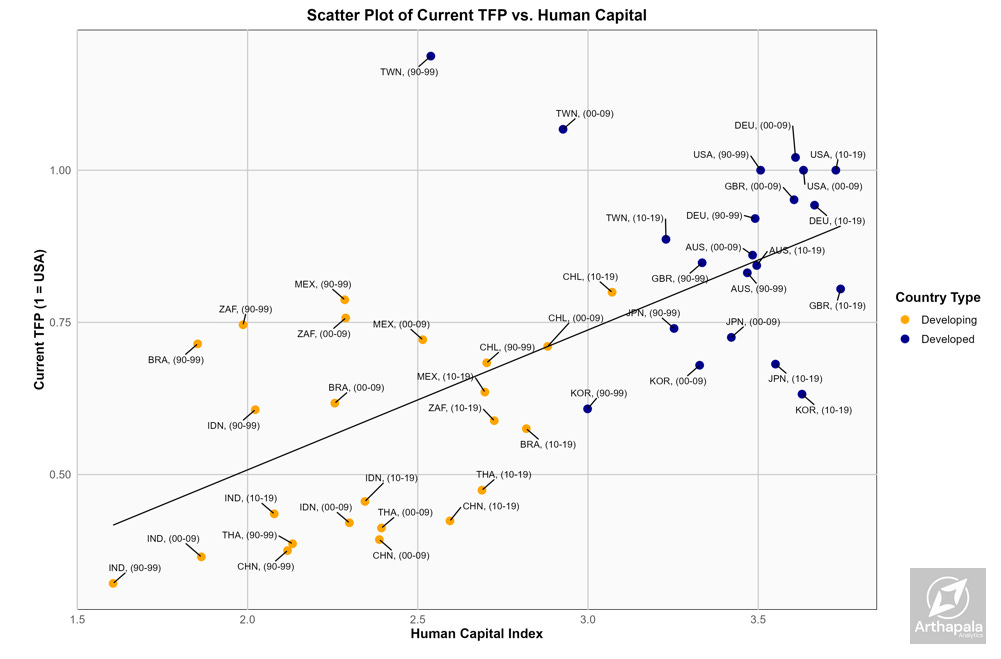
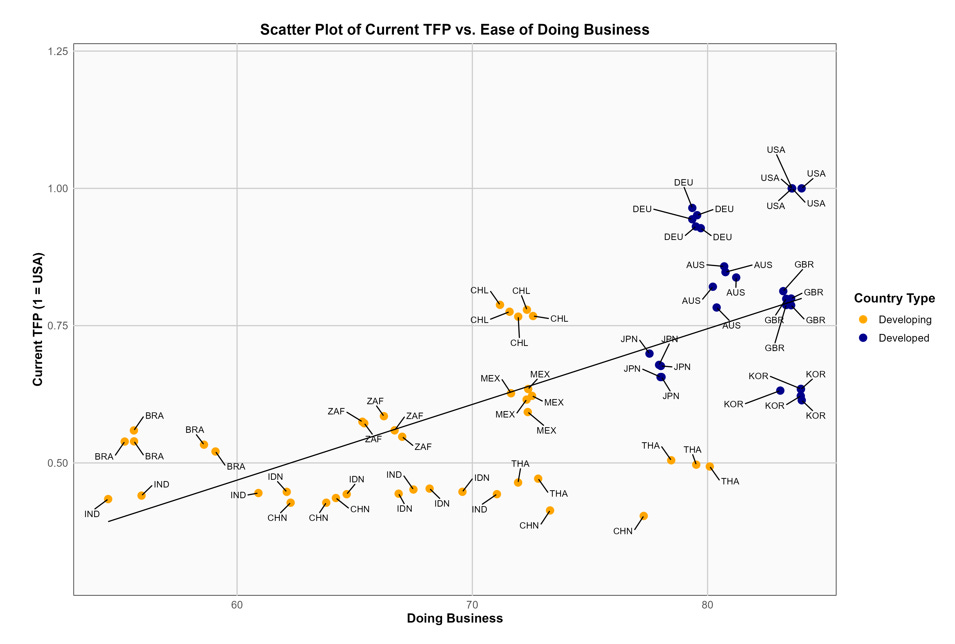
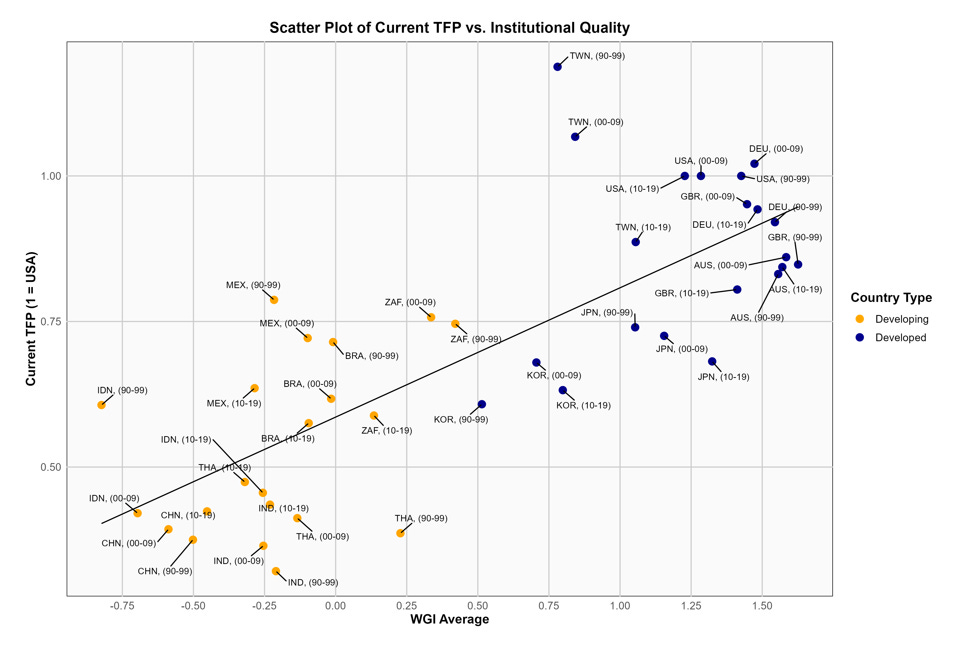
TFP is usually introduced as the residual “A” in the production function: output left unexplained by capital and labor. The conventional story is familiar. TFP rises when countries innovate, educate workers, improve infrastructure, strengthen institutions, and make markets more efficient. Figures 1–3 support this baseline. Figure 1 shows that countries with higher human capital tend to have higher measured TFP. Figure 2 shows a positive association between market efficiency and TFP, suggesting that productivity depends partly on whether resources can move toward better uses. Figure 3 adds the institutional layer: countries with stronger governance quality also tend to record higher TFP. These figures are correlations, not causal proof, but they point to a common idea in the productivity literature: TFP depends not only on what an economy has, but on whether its rules, markets, and institutions allow resources to be used well.
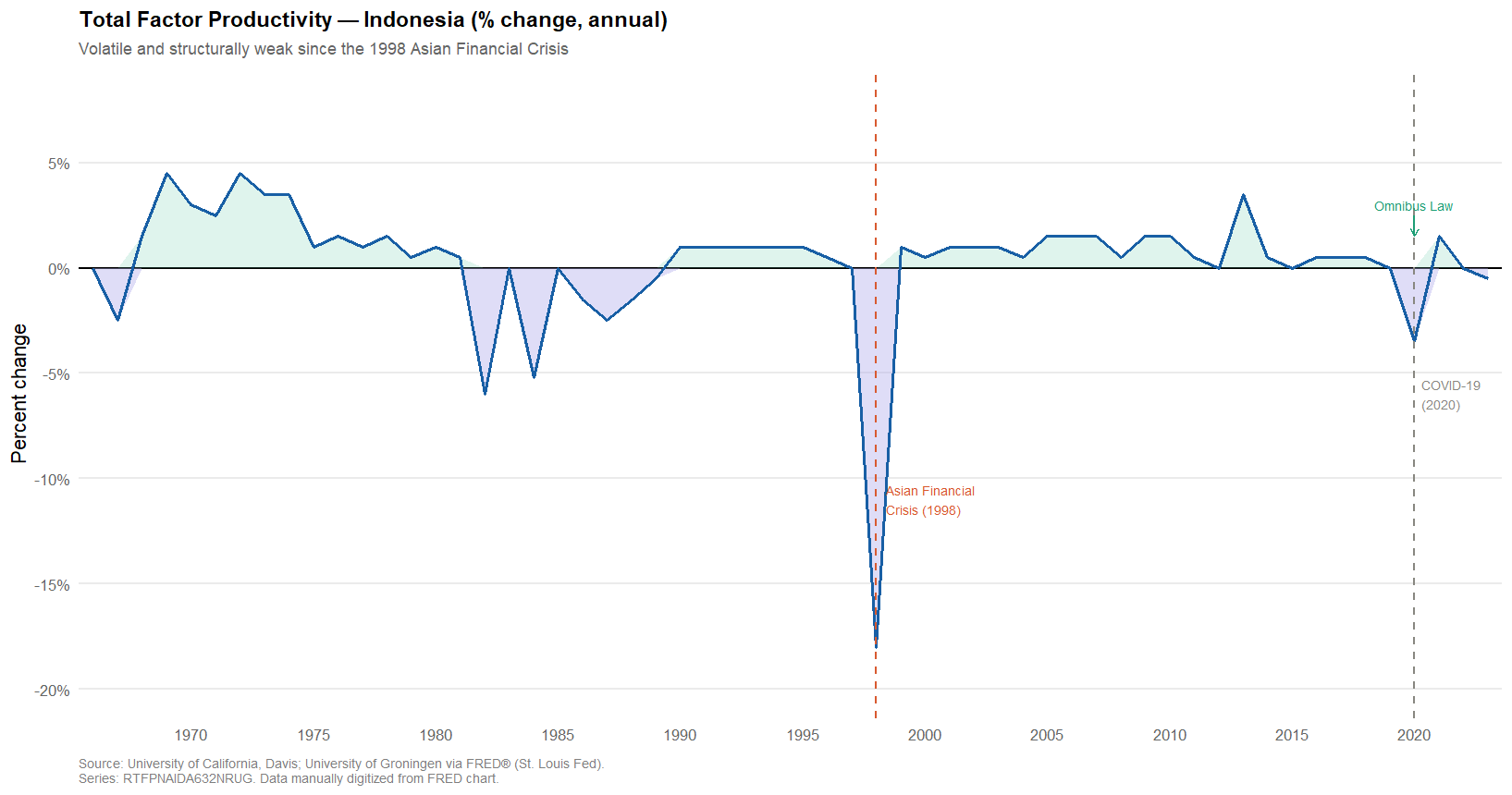
Indonesia’s own TFP path gives this debate a practical urgency. Figure 4 shows that Indonesia’s annual TFP growth has been volatile: large contractions during the Asian Financial Crisis and COVID-19, followed by recoveries, but not a smooth upward trend. In the FRED/Penn World Table series, Indonesia’s TFP index stood at 0.99552 in 2023, still below its 2019 level of 1.00802. This should not be read only as a pessimistic story. It suggests that Indonesia still has room to raise productivity if the right bottlenecks are addressed. The question is where future TFP gains might come from.
The missing link that is often overlooked is within the labor market. In Lagos’ (2006) model of TFP, productivity does not simply fall from the sky as an external technology shock. It emerges from labor-market frictions where jobs are created, destroyed, accepted, and rejected. Each worker-firm match has its own productivity. Some matches are productive enough to survive; others are not. The key mechanism is selection. The economy has a reservation productivity threshold: a cutoff that determines whether a match continues or disappears. If the cutoff is higher, fewer low-productivity matches survive, and average productivity among active jobs rises. If the cutoff is lower, more low-productivity matches remain, and measured TFP can be weaker.
This matters because it turns TFP from a purely technological concept into a labor-market outcome. Productivity depends not only on machines, skills, or infrastructure, but also on which jobs survive, which firms expand, and where workers end up. In this view, the labor market is not just a place where employment is counted. It is a sorting mechanism. It decides whether workers are matched with firms that can use their skills productively, or whether they remain in low-productivity work.
This mechanism is useful for thinking about Indonesia. In a dynamic economy, weak matches should eventually be replaced by better ones: workers leave less productive jobs, productive firms expand, and labor moves toward higher-value activities. But if workers are absorbed into informal, stagnant, or survival-based employment, that selection process may be weaker. The economy may still “employ” people, but not necessarily in jobs that raise average productivity. This is why informality may matter for TFP: not because informal workers are inherently unproductive, but because informality can limit the pathways through which workers move into firms that train, scale, and upgrade them.
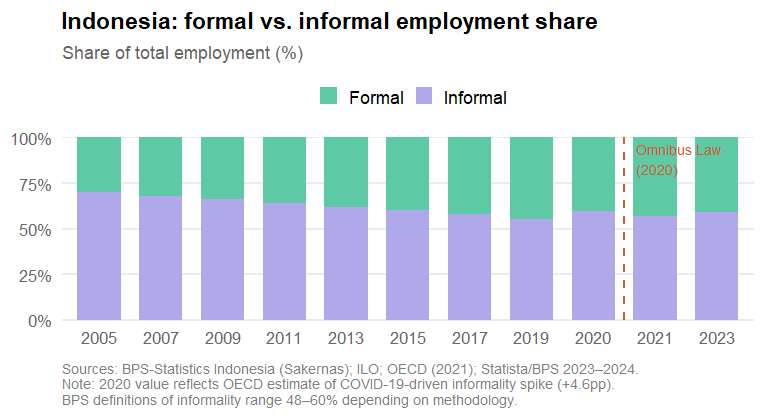
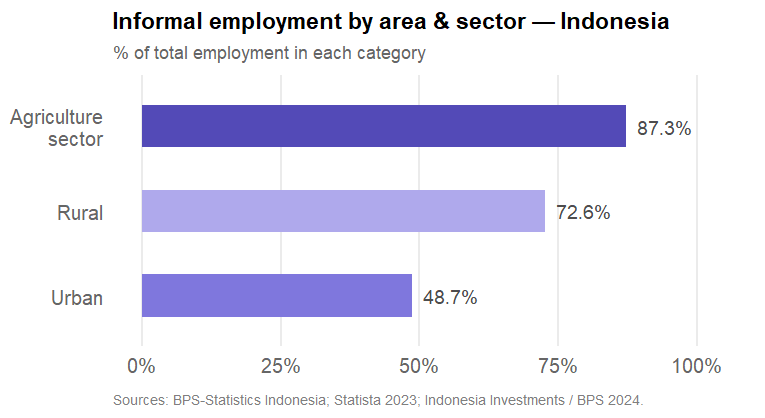
Labor absorption therefore becomes central to the productivity debate. To see why, we need to look at Indonesia’s labor-market structure. Figure 5 shows that informality still dominates employment: BPS records informal workers at 59.11 percent of total employment in 2023. Figure 6 shows that this informality is unevenly distributed, especially high in agriculture and rural areas. This matters because informality is not merely a legal category. It often reflects smaller firms, weaker training, lower access to finance, limited worker protection, and fewer pathways into productivity-enhancing jobs. World Bank research similarly finds that informality in Indonesia remains elevated, concentrated in agriculture and low-skilled services, and associated with productivity, education, and wage gaps between formal and informal workers.
This changes the productivity story. Human capital does not automatically become TFP. A worker trained for modern manufacturing or digital services cannot raise productivity if the economy mostly absorbs labor into petty trade, low-productivity services, or survival self-employment. The issue is not simply that Indonesia needs “more skills.” It needs a labor market that converts skills into productive work. Recent World Bank data reinforces this concern: youth labor force participation remains low at 49.6 percent, youth unemployment is high at 17.3 percent, and real wages have stagnated especially in labor-abundant sectors such as construction and manufacturing.
A reasonable counterargument is that this overstates labor markets. Indonesia’s TFP problem may be more about weak innovation, infrastructure gaps, institutional quality, or limited firm capabilities. Better matching cannot substitute for technology adoption or investment. That objection is right, but incomplete. Technology does not diffuse by itself. Infrastructure does not allocate workers by itself. Education does not guarantee productive employment by itself. These inputs must pass through firms and labor markets. If productive firms cannot expand, if informal firms remain too small to train workers, if job information is weak, and if workers cannot move toward better opportunities, then productivity remains trapped.
This is why the policy implication should not be “formalize everything by decree.” The goal is to build pathways from informal and low-productivity work into better matches. That means improving labor-market information, linking vocational training to actual firm demand, helping small firms grow into formal employers, reducing barriers that prevent productive firms from expanding, and designing social protection that supports worker mobility rather than locking people into bad jobs.
Indonesia’s TFP debate already recognizes human capital, market efficiency, institutions, and allocative efficiency. The missing labor-market link is to ask where workers actually go. Productivity is not only created in schools, factories, or infrastructure projects. It is created when workers are matched with firms that can use their skills, train them, and scale their output.
Figures