

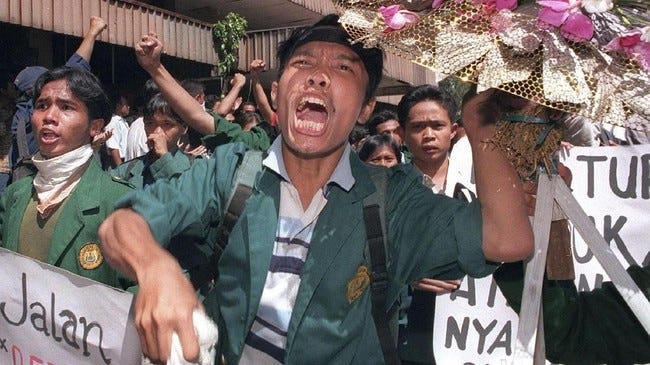
In many political rallies, the youth are often the face of the movement. In 1998, tens of thousands of Indonesian students protested against the New Order, leading up to the resignation of the president after 32 years in power. Most recently, a Gen-Z backed movement overthrew the Nepali government. Even in classic literature, the youth political spirit is well documented, such as Enjolras and his student society in Victor Hugo’s Les Miserables.
Nepal, 2025. Indonesia, 1998. Paris, the June Rebellion in 1832. Yes, the youth were the face of the protest. However, there are also more things they have in common. They all share an underlying economic issue. Youth unemployment and outmigration in Nepal, a financial crisis in Indonesia, cholera and food prices in Paris. In times of crisis, the youth moves first.
But everyone felt the crisis. So why was it the students that were on the street? After all, who could afford to be on the street on a Tuesday?
The youth possess the lowest opportunity cost in terms of joining a rebellious movement. This simply implies that compared to older age groups, they have less to lose. Fewer labor market attachments, fewer family commitments as well as societal relations, fewer things that might be jeopardized should they get into political trouble. Additionally, the youth have the most to gain from major reforms. The vision of a “better future” naturally appeals more to those who expect to live long enough to see it. With a lower cost, as well as a higher benefit, youth uprisings could be viewed as a rational choice.
This is what Chaba et al. (2027) find in their study. They based their study on the rational-choice model of democratisation that predicts an elite to give up their power when the threat of revolution becomes too high. The abundance of the youth population simply increases the amount of people that are incentivized to protest. Using a country panel fixed-effect, they found that having a higher youth ratio results in a democratic improvement. An instrumental variable is further used to address the concern that politics might be driving demography rather than the other way around.
They also found that macroeconomic crises increase the probability of revolts. The loss of livelihoods caused by crises is a likely way for a movement to ignite. Paired with a large youth population facing lack of employment, the mechanism works in the same direction towards unrest. This could also be the reason why the 1998 crisis was firstly a currency collapse, before it transformed into a student movement.
However, another strand of literature found that instead of democratic improvements, a large youth population could lead to political violence instead. Urdal (2007) found that these “youth bulges” raise the risk of armed conflicts, terrorism, and riots, and the relationship holds even after controlling for development and democracy. But both results could be true at once. What a youth population provides is pressure. It lowers the cost of political protest and increases the number of people willing to do it. What this pressure buys, whether it be democratic reform or years of violence, is another matter entirely. Something that most likely won’t be resolved by demographics itself.
So the rational choice explains who shows up, and perhaps when. It says far less about what they walk away with. A movement can make the threat credible without having much say in the response, and the response is not always a giving up of power. Sometimes it is just repression, and sometimes it is a long conflict that nobody chose.