

Pancasila consists of five interrelated principles that became the ideological basis of Indonesia, encompassing aspects such as religious rights, human rights, national unity, democracy, and social justice.
I contend that Pancasila’s principles failed to be fully translated into the operational level, resulting in inconsistent contract enforcement within Indonesian institutional practice. Symptoms of failures in the operationalization of Pancasila are provided with historical evidence, exemplified by a series of instability, power concentration, and corruption, among others.


Historical Context of Pancasila and the Indonesian Government
Pancasila was first introduced at the first session of the Investigating Committee for Preparatory Work for Indonesian Independence. The session emphasized the necessity of a foundational philosophy that encompasses the religious, racial, and cultural diversity of Indonesia (Azis 2025:62). Pancasila was presented by Ir. Soekarno on the 1st June 1945, and produced an initial consensus for the state philosophy of Indonesia (Azis 2025:64). The result was formalized through the Jakarta Charter on the 22nd of June 1945, containing the five principles of Pancasila.
The establishment of Pancasila as the state philosophy reflects the compromise undertaken for the sake of national unity. Although formulated on the 22nd of June, its final form only appeared on the 18th of August 1945, one day after the proclamation of Indonesian independence. The first principle of Pancasila in the Jakarta Charter was highly contested by religious and ethnic minorities, due to a strong leaning on Islamic religiosity (Azis 2025:65). The first principle was then changed from “Belief in God, with the obligation to carry out Islamic law for its adherents” to “Belief in the one and only God” to ensure religious neutrality within the Indonesian institutional arrangement (Kurniasih & Isma’il 2024:167-168).
Its final form was embedded in the 1945 Constitution of the Republic of Indonesia. The document asserts Pancasila as a source of national guidance and the defining value of the Indonesian nation (Kurniasih and Isma’il 2024:169). Hence, it emerged as the primary reference for determining future formal constraints and shaping informal constraints within Indonesian institutions.
Informal Constraints, Formal Constraints, and the Incomplete Contract Theory
Informal constraint is largely associated with culture, broadly defined as transmitted information via knowledge, values, and other aspects that may influence human behaviour (North 1990:37). Formal constraints include political, legal, and economic rules and contracts and function to lower enforcement costs, supporting informal constraints as possible alternatives to more complex exchanges (North 1990:46-47). Consequently, formal constraints, complementing informal constraints, provide a more stable basic structure of exchange, enabling foreseeable agreement (North 1990:50).
Formal rules do define the structure of rights, but, due to the costliness of measuring the enforcement characteristics of exchange, most contracts are incomplete (North 1990:61). The issues concerning the measurement and enforcement of these rights consist of the structure of property rights, the strength of the legal system, and the development of norms and voluntary arrangements (North 1990:64).
Consequently, cultural norms and informal constraints will contribute more significantly to achieving agreement (North 1990:61). Higher costs of measuring and enforcing rights will force parties to exchange within the boundaries set by informal constraints, or worse, abort the exchange (North 1990:68). Such a limitation highlights the consequences of incomplete contractual arrangements, resulting in uncertainty of exchange when future enforcement of rights and anticipation of events is unsettled.
Due to the impossibility of creating a complete contract, parties will attempt to write an incomplete contract and, as a consequence, make it a subject for continuous revision (Hart 1988:123). Under such conditions, ownership becomes significant because residual rights of control cannot be fully specified or given up (Hart 1988:124). Thus, parties with higher authority over institutional arrangement will have the capacity to interpret and operationalize unresolved aspects of the contract.
Pancasila within the Framework of Incomplete Contract Theory
Pancasila provides normative constraints for social structure, implicating the basic institutional arrangements of Indonesia. The five principles of Pancasila embedded in the Indonesian constitution are effectively a source of formal guidance for legal and political procedures. The incentives are then shaped through legal consequences, displaying Pancasila’s authority in producing formal and informal constraints.
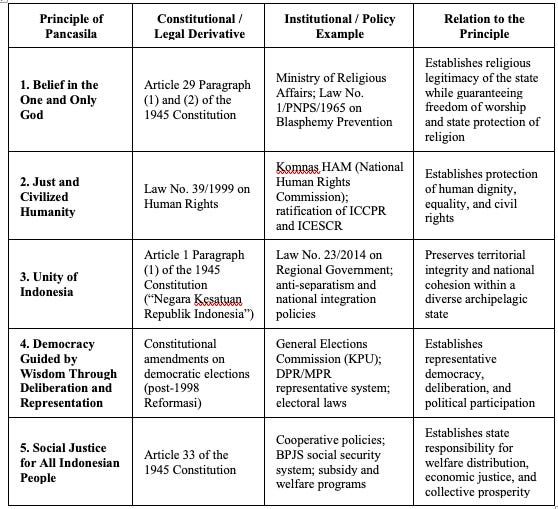
Despite its final form, Pancasila is a subject of incomplete contractual arrangement. The interpretation of Pancasila would become a subject for constant debate throughout Indonesian history. Ir. Soekarno presents Pancasila as a set of uniting principles amid cultural and ideological differences. His regime uses Pancasila as an instrument to unite different factions, openly expressing it as an instrument to unify the nation with other philosophical ideas such as Islam (Lev 1966:125).
Soeharto’s New Order imposed a stricter reinforcement of Pancasila through institutional mechanisms such as the P4 program to anticipate differing interpretations (Ward 2010:30). The post-reform regime, however, abandoned the New Order’s approach to sole interpretation of Pancasila, claiming it as a destabilizing factor that may contribute to political instability and radicalisms within the newly-formed democracy (Ward 2010:37).
Such turbulence showcases the role of Pancasila as a final source of national guidance, while at the same time underlining its difficulty for a consistent operationalization. The differing interpretations of Pancasila display its potential for exploitation. One that reflects an incomplete specification within the institutional framework.
Differing interpretations and reinforcements of Pancasila imply that its authority is also dependent on executive power. Aligned with Hart, such a case suggests the evidence that, within the Incomplete Contract Theory, the government may assert a certain arrangement within the Indonesian institutional landscape. The interpretation is heavily influenced by the perception of national figures, as shown by Soeharto, Soekarno, and post-reform factions with their differing approaches to instrumentalizing Pancasila as a guiding principle.
Such a case is also highlighted by North, arguing that although government could act as a third-party enforcer to uphold contracts, it risks them exerting their interests regardless of their impacts on society (North 1990:59). It then presents a dilemma, for if government should act as the ultimate authority to enforce Pancasila as a contract, misinterpretation regarding its enforcement will not be able to become a subject for contest.
Empirical Evidence of Operationalization Flaw of Pancasila as a Contract
The limitations of Pancasila’s operationalization are illustrated by several empirical cases. Violations of principles, encompassing aspects including religious freedom, human rights violations, democratic backsliding and persistent inequality, are persistent. Illustration of empirical evidence regarding such inconsistencies are illustrated in Table 2.
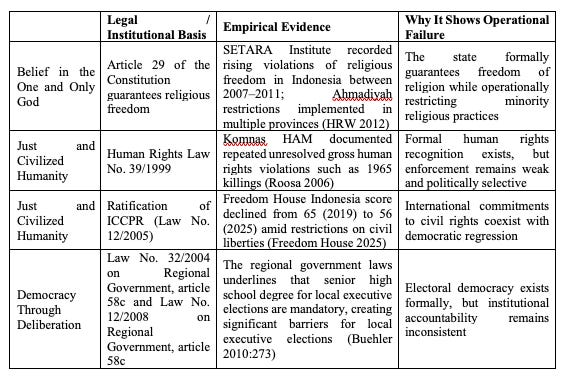
They illustrate violations of Pancasila’s principles with both the government and civil society as the subjects under scrutiny. Religious tolerance is guaranteed within the framework of Pancasila, but evidence shows it can be undermined within local practices. Religious rights are often sought through prosecution, signalling the government as a source of resolution within the contract. This evidence shows that, despite Pancasila as a source of constraint, norms and cultural aspects within the local context are often more powerful constraints for institutional arrangement.
Evidence of human rights abuses and democratic backsliding signals the benefit of interpretive authority embodied in executive power. The 1965 killings of the communists party members highlight extreme initiative taken by Soeharto’s military regime to undermine contesting political power, namely the communist party (Roosa 2006: 206). Approximately more than 600.000 individuals are killed (Cribb 2002:558). But despite such initiative, Soeharto’s P4 program signals his commitment to uphold Pancasila’s principles, showcasing past structural inconsistencies in defining and defending Pancasila.
Such inconsistencies continue into the era of reformation, showcased by democratic regression through the persistence of elite politics. Following the reform in 1998, the transfer of administrative and fiscal authority to the local government has also created opportunities for political participation. However, a significant barrier remains at the local level. Newly existing regulations gave significant advantages to the elite, through mechanisms that include educational threshold, notation from parties or party coalitions, and campaign costs. All of which undermines the role of the underprivileged in the Indonesian political contest (Buehler 2010: 273-274).
Taken together, this evidence signals that Pancasila’s operational inconsistency is structural, rather than incidental. Hart’s (1988) idea of residual rights of control becomes increasingly relevant because a large part of the interpretive power regarding Pancasila is influenced by the governmental body. Such an arrangement produces interpretive versions of Pancasila that are politically motivated and structurally enabled.
Synthesis: Empirical and Theoretical Misalignment
I argue that failure to achieve a more consistent interpretation of Pancasila’s principles is deeply rooted in its inability to contest more powerful informal constraints in the divergent Indonesian region. Although it had become embedded within the constitution, the Indonesian society is still deeply shaped by informal norms, such as local religious codes, elite networks, and historically entrenched hierarchies that Pancasila’s principles were never specific enough to displace. Pancasila then functions as a source of compromise, rather than an operational guidance, despite presenting itself as a social contractual arrangement.
Despite formalization, informal rules and norms often change incrementally (North 1990:91). This is especially so in a divergent society such as Indonesia. The lag between informal constraints and formal constraints imposed by Pancasila often produce conflicts as many became inconsistent with one another. The formal rules often create a partial equilibrium that undermines the cultural inheritance that shapes informal constraints (North 1990:91). Thus, informal constraints persist as a signal of enduring effectiveness within the local context, due to its ability to solve coordination problems (North 1990:91). The product of such arrangement is often a gradual restructuring of existing constraints, to produce a more stable equilibrium.
Moreover, influences of Pancasila’s principles as formal and informal constraints differ in each region. It can be argued that Indonesian local context possesses a significant degree of path dependence. North (1990:101) contends that differences in relative bargaining power among parties operating under common rules will have a different marginal adjustment, and does not necessarily lead to a convergence.
North illustrates the idea of different marginal adjustment using the case of the implementation of the US Constitution in Latin American countries. Despite having the same formal rules, differences in enforcement mechanism, local norms and behaviours, and subjective models resulted in different structures of incentives and policy consequences leading to a variety of outcomes within local context (North 1990:101). The same logic applies to Pancasila: a uniform framework produced varied institutional outcomes across Indonesian regions because the informal constraints it encountered were never uniform in the first place.
This interpretive gap is then filled by allocation of residual rights of control. Hart (1988:124) argues that when contracts are incomplete, ownership becomes more important because the decision on matters unspecified in the contract rests with one with higher authority. In the Indonesian context, the abstract conceptualization of Pancasila leaves residual interpretive authority unassigned. This authority is captured by whoever has institutional power, as illustrated by differing interpretations and implementations of Pancasila’s principles. Such an arrangement reflects a structural flaw of the contract itself, in the midst of the persistent influence of heterogeneous informal constraints within Indonesian regions.
This gap continues even after the reform. The Constitutional Court (MK) was designed to distribute interpretive authority, but the 2023-2024 controversy over the vice-presidential age limit showcases that even the integrity of such an institution is also a subject for executive influence (Budiono et al. 2024). Thus, residual rights were never fully transferred, and formal constraints can fail without informal backing.
Ultimately, the misalignment between Pancasila’s legitimacy and operational consistency is not incidental or regime-specific. It is structurally embedded in the contract’s incompleteness, sustained by the influence of local constraints and enabled by residual authority in successive holder of institutional powers.
A Complementary Framework: Self-Reinforcing Contracts
Pancasila’s incompleteness as a contract is not a solvable design. Thus, the relevant question is not to eliminate the existence of residual rights of control, as its existence will remain within Pancasila as a form of contract. Rather, it is how to stabilize its enforcement without relying on the government as a primary interpreter.
Institutional change is largely shaped by increasing returns. Drawing from Arthur’s four self-reinforcing mechanisms on how certain technologies stay dominant, he contends that large setup costs, learning effects, coordination effects, and adaptive expectations become the main principles for a sustainable institutional arrangement (North 1990:94-95). Pancasila has benefited from a large setup cost through the process of independence, and has endured different regimes that contributed to continuous learning effects.
However, I contend that Pancasila needs to leverage the dynamics of coordination effects and adaptive expectations. Such an initiative is done by distributing the interpretive authority across civil society, religious institutions, and regional bodies. The government’s role as the primary enforcer of Pancasila would be diminished, and subsequently, increasingly anchored on the coordination needs of Indonesian society.
This does not eliminate the contract incompleteness, but it transforms the residual rights of control into something that can be contested and negotiated. Consequently, the sustainability of Pancasila as a contract will not depend on a singular authoritative body. It will remain within the hands of the Indonesian people.
Conclusion
Pancasila’s persistent operational inconsistency is not incidental, but structurally embedded. It is sustained by heterogeneous informal norms and amplified by the existence of residual rights of interpretive authority within the government body. Yet, the incompleteness of Pancasila is also a cause of its durability. The relevant change is then not to complete the contract, but to distribute the residual rights of control to ensure a more stable equilibrium for Pancasila as a contractual arrangement.
References
Azis MA (2025) ‘BPUPKI dan proses perumusan pancasila sebagai dasar negara’, Maliki Interdisciplinary Journal (MIJ), 3:62-67, http://urj.uin-malang.ac.id/index.php/mij/index
Budiono I, Tanjung AD, and Rahman F (2024), ‘Ambiguity after the constitutional court decision number 90/PUU-XXI/2023 regarding the presidential election’, Jurnal Hukum Prasada, 11(2):111–118, https://doi.org/10.22225/jhp.11.2.2024.111-118.
Buehler M (2010) ‘Decentralisation and local democracy in Indonesia: the marginalisation of the public sphere’, in Aspinall A and Mietzner M (eds) Problems of Democratisation in Indonesia : elections, institutions and society, Institute of Southeast Asian Studies (ISEAS).
Cribb R (2002) ‘Unresolved problems in the Indonesian killings of 1965–1966’, Asian Survey, 42(4):550–563, https://doi.org/10.1525/as.2002.42.4.550.
Freedom House (2025) Freedom in the world: Indonesia, Freedom House Website, accessed 4 Jun 2026.
Hart OD (1988) ‘Incomplete Contracts and the Theory of the Firm’, Economics, & Organization, 4(1):119-139.
Human Rights Watch. (May 5 2012) ‘Indonesia: Rights Record under Scrutiny at UN’, Human Rights Watch, accessed 4 June 2026.
Kurniasih M and Isma’il M (2024) ‘Dari BPUPKI ke Pancasila: refleksi sejarah pembentukan negara dan pendidikan kewarganegaraan di Indonesia’, Jurnal Komunikasi Antar Perguruan Tinggi Agama Islam, 23(2):162–180.
Lev D (1966) The transition to guided democracy: Indonesian politics, 1957-1959. Ithaca : Modern Indonesia Project.
North DC (1990) Institutions, institutional change and economic performance, Cambridge University Press, https://doi.org/10.1017/CBO9780511808678.
Roosa J (2006) Pretext for mass murder : the September 30th Movement and Suharto’s coup d’état in Indonesia, University of Wisconsin Press.
Ward K (2010) ‘Soeharto’s Javanese Pancasila’, in Aspinall E and Fealy G (eds) Soeharto’s new order and its legacy : essays in honour of Harold Crouch, ANU E Press.