

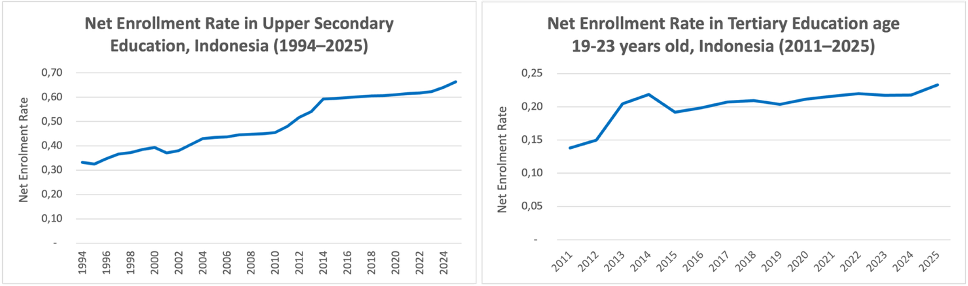
Over the past few decades, Indonesia has experienced a rapid expansion in higher education (HE) enrollment. Since 1998, the share of tertiary education completion has more than doubled and continues to increase. The exponential growth is driven by a series of demand-side and supply-side factors, including multiple government and private-led education programs, along with the growth of multiple distribution platforms for higher education advertisements. This resulted in an especially sharp rise in enrollment for high school, undergraduate, and postgraduate levels since the mid-2000s.

Amid the expansion of higher education, the composition of unemployment by educational attainment has also shifted. Since the late 2000s, the proportion of university graduates among the unemployed has increased significantly, consistently reaching double digits in the 2010s and 2020s. In contrast, the share of senior secondary (SMU) graduates among the unemployed has changed only slightly over time, averaging around 28 % since 1986.
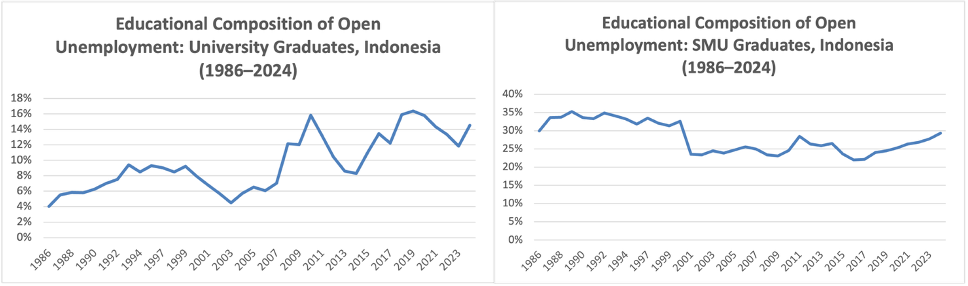
This pattern suggests a structural shift in the composition of unemployment within the Indonesian labour market. That is, the proportion of university graduates’ unemployment has risen relative to the total open unemployment pool. Such evidence signals an absorption failure in the labour market for university graduates, potentially highlighting a labour market mismatch during extensive higher education expansion initiatives.
This evidence presents a conundrum. Isn’t more quality education supposed to be good for the economy? Isn’t it supposed to increase the value of human capital, boost productivity, and thus create more jobs? Why does that not seem to be the case, especially when the Indonesian economy is growing?
First, we have to understand the proposed mechanism for which education could increase wage and employment outcome. Theoretically, Becker (1964) highlights that education is a form of capital investment. Just like how firm invests in machines, individual invests in skills. Both are expected to produce future returns. Becker models it with the following equation.
In the model, Y represents income after education, X represents income without additional education, while C represents the cost of education, and r illustrates its rate of return. The mechanism he proposed is that when people acquire education, they expect some sense of return. When they spend time and resources to obtain an education, including tuition, time spent studying, and foregone earnings, they expect future benefits. This increases the expectation of workers’ productivity by firms, resulting in higher wages and lower unemployment. Therefore, in an equilibrium, education should improve labour market outcomes.
Spence (1973) highlights the function of education as a signal of workers’ ability. Education may not primarily increase skills, but it may signal a worker’s ability to employers. Therefore, in an equilibrium, high-ability workers are predicted to have better education and wages based on observed signals taken by firms and hirers.
However, Indonesia presents a case where these models are not functioning properly. That is, Becker and Spence argued that education is supposed to produce a positive signal of workers’ ability and enhance labour market outcomes. Evidently, there seems to be a discrepancy of the proposed mechanism resulting in what seemed to be a labour market failure.
Such failures have been studied in extensive mismatch literature. Duncan and Hoffman (1981) argued that overeducation could happen when the education level increases more rapidly than the skill requirements for available jobs. In such cases, workers may obtain education levels that exceed the qualifications required by their jobs. This leads to a schooling surplus, where individuals are hired below their education level, resulting in an inefficient allocation of human capital.
Structurally, Pritchett (2001) highlights evidence that educational attainment in developing countries does not directly contribute to growth as predicted by foundational economic models. He argued that mismatches and institutional arrangements were sometimes unaccommodating of growth, resulting in counterproductive educational initiatives. In particular, he highlights the case where countries’ demand for growth for higher-skilled labour failed to meet the pace of their expansive educational initiatives. He also highlighted that their ability to transmit knowledge and skills effectively through educational programs also plays a role. This signals a potential case when rapid education expansion will not translate into employment opportunities.
A related structural explanation is presented by Dani Rodrik (2016), who argued that a misaligned transformation, illustrated by premature deindustrialization, will hinder growth for developing countries without a comparative advantage in manufacturing. He argued that manufacturing will produce an unconditional labour productivity convergence, meaning that it will produce growth quickly if they industrialized. He also showcased that manufacturing can absorb low-skilled workers more effectively, in contrast to non-industrialized and service sectors that require highly skilled labour. He illustrates the case of some African and Latin American countries that have been enduring the consequences of premature deindustrialization, showing signs of an increase in informality and petty services despite growing investment. These underline the central role of manufacturing in driving catch-up growth, and the danger of prematurely transitioning into a high-skilled sector.
For the demand side, Van De Werfhorst (2009) presents a case where education has evidently transformed into a positional good. He highlights that educational pursuits were also significantly driven by social-class pressure, underscoring the phenomenon of credential inflation amidst the loss of educational value. As a result, demand for education steadily rises even without rewarding job market consequences.
Altogether, these combinations may signal that Indonesia is experiencing structural challenges, facing a mechanism failure in the current labour market ecosystem. With a growing number of educated populations and a rising share of university graduates in unemployment composition, Indonesia’s labour market failed to absorb a significant number of the educated workforce. This raises an important policy question: What is the current strategy for Indonesia’s government for higher education expansion, and where will it take us?
Indonesia’s grand development strategy for education is embedded within a broad national development strategy, emphasizing structural transformation. The National Long-Term Plan (RPJPN 2025-2045) acknowledges the weaknesses of the current manufacturing climate, the signs of premature deindustrialization, and poor research and development capability. The document emphasized the importance of higher education initiatives to increase productivity, along with downstreaming as a strategic initiative for growth and development.
On paper, Indonesia’s long-term development plan presents a coherent framework for sustainable growth. However, its success is highly dependent on short-term implementations. And so far, the alignment between the short-term trajectory of labour market development and its long-term vision has been questionable at best.
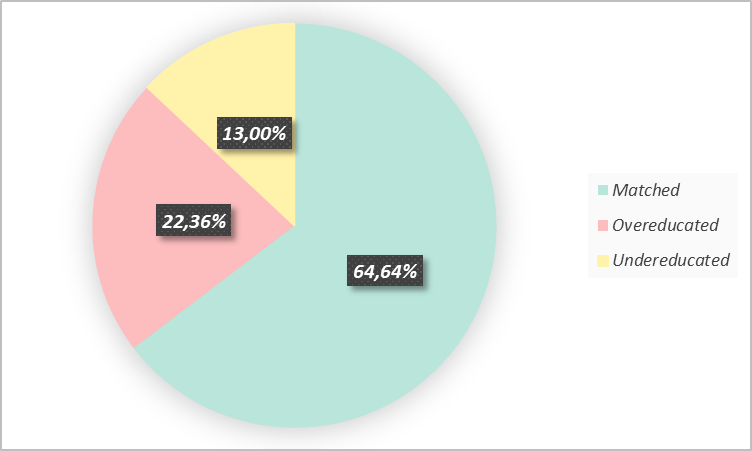
Indonesians are enduring problems regarding labour mismatch, including overeducation and undereducation. As discussed, unemployment amongst university graduates having also been rising. This pattern is shows that there is a clear sign of labour market misalignment amidst HE expansion.
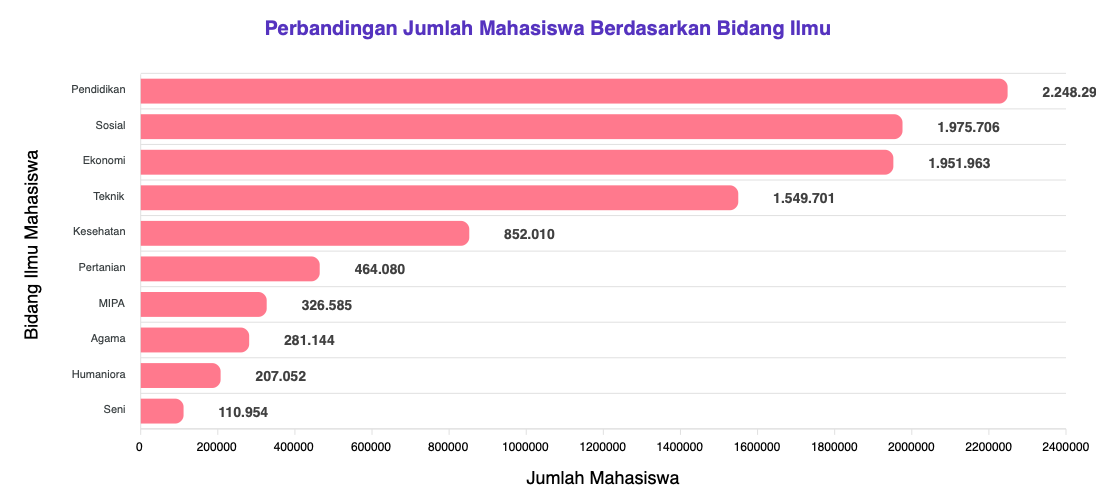
If we examine the composition of undergraduate students in 2025, most are enrolled in the degree that would presumably directly contribute to the service and non-manufacturing sectors. Primarily, enrolment are concentrated towards education, social, economics, and healthcare sectors.
Furthermore, if we take a look at the employment composition, the primary sector, being agriculture, forestry, and fishing, along with service sectors (retail, accommodation, and education), still dominate the employment share of the job market. More importantly, they are growing at a similar rate to the secondary sector, signalling labour market absorption failure in manufacturing industry. This highlights that the manufacturing sector failed to grow at a targeted rate despite evident policy prioritization.
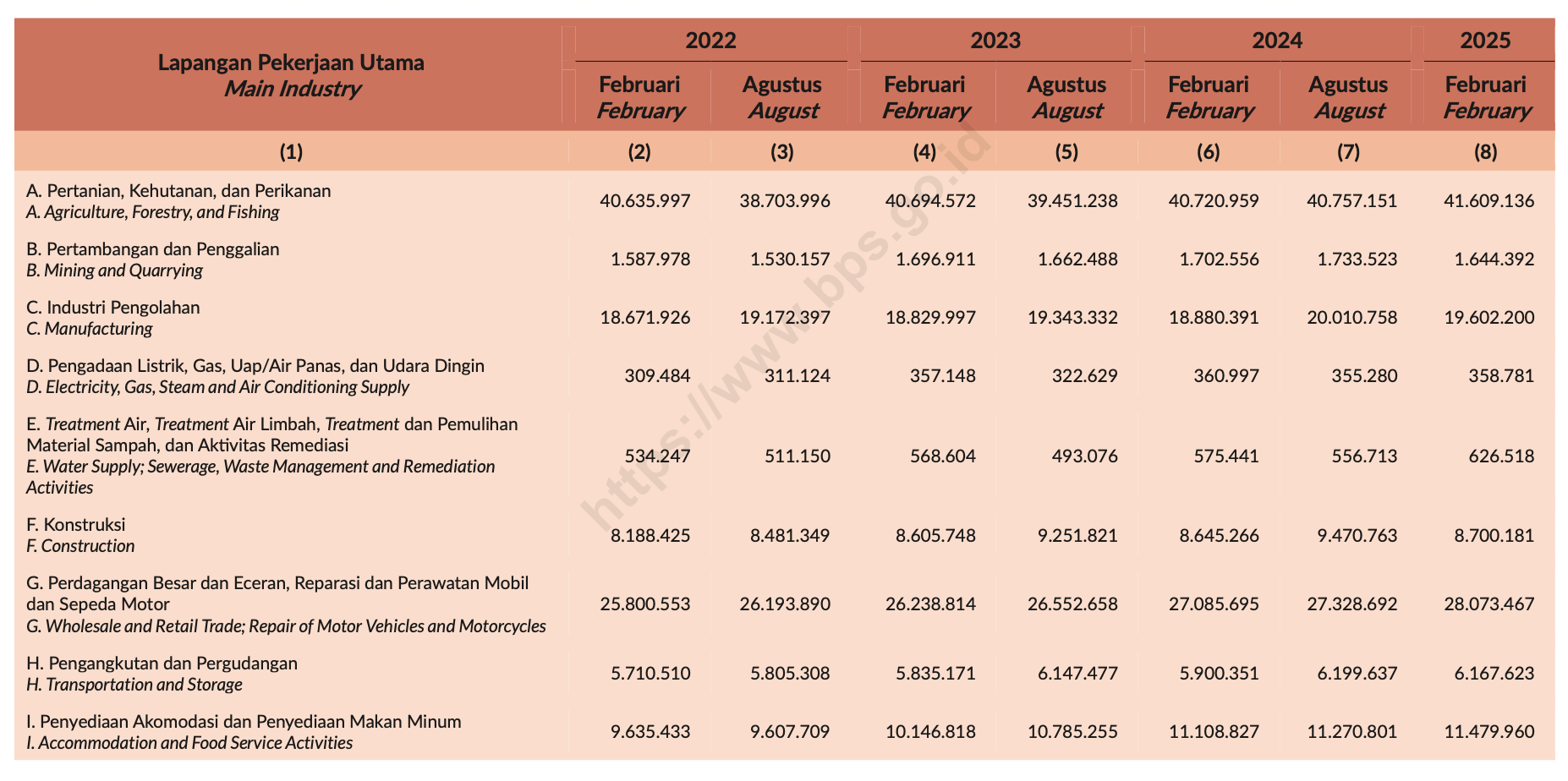
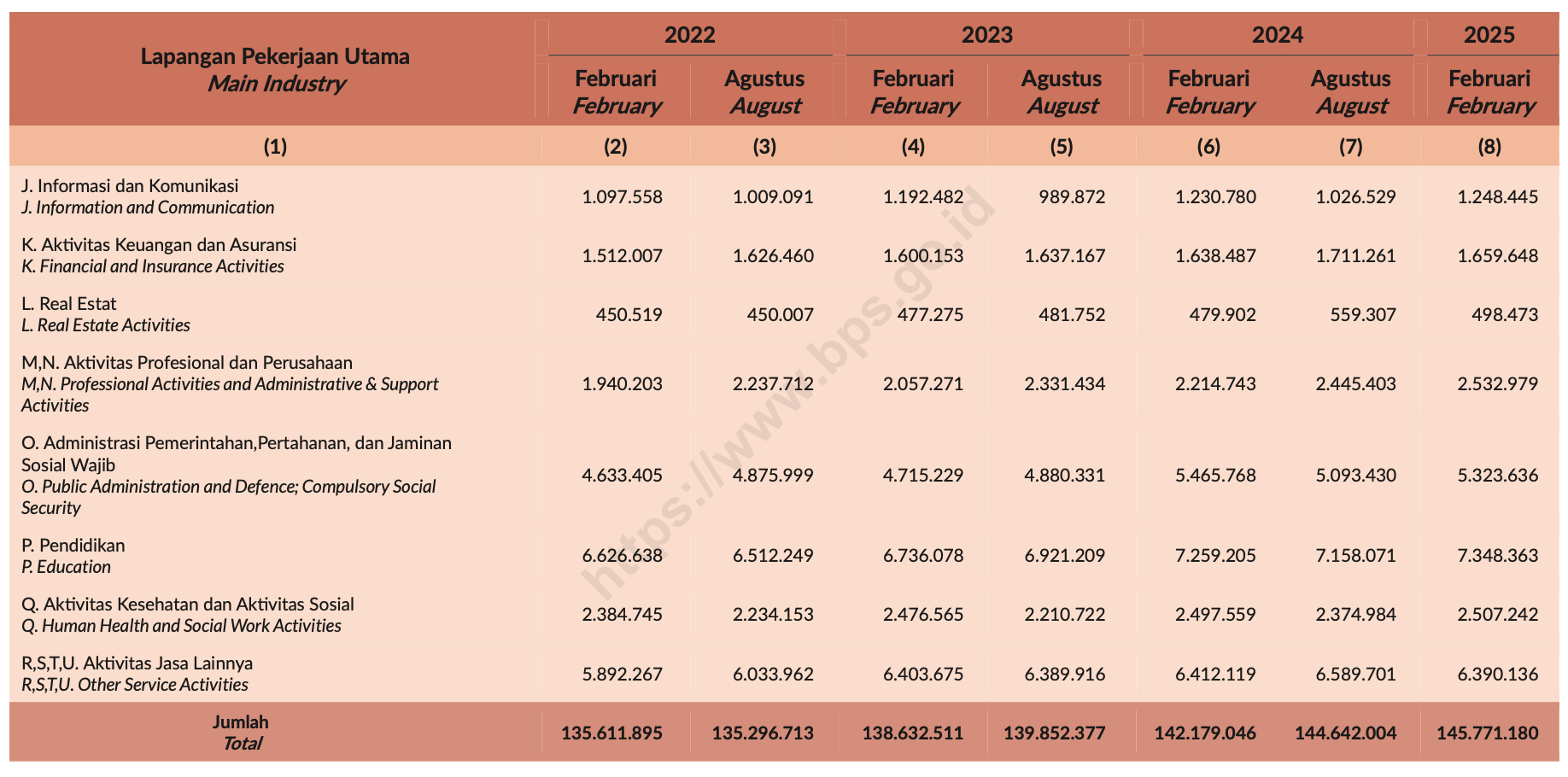
In response to the current labour market situation, the government tend towards a more interventionist approach. Welfare programs such as Makan Bersama Gratis (MBG) signal massive boosts for the service sector, particularly the food and agricultural sectors. However, whether such an initiative will translate into a meaningful development consequence, especially in the middle of rising unemployment, remains an open question.
Another massive program, Koperasi Merah Putih, also became a source of scrutiny. With a promise to initiate a top-down institutional design for more than 80,000 rural cooperatives, the government also proclaimed it as a substantial program to help ease the problem of rising unemployment. Through loans channelled by Bank Himbara, the government presented Koperasi Merah Putih as a vehicle for rural development. However, being concentrated in the service sector, the prospect of Koperasi Merah Putih becoming a proper vehicle for substantial labour market development is still highly doubtful. Not to mention, with the current institutional design, one being a top-down initiative that contrasts the autonomous and bottom-up approach of cooperatives, a question of the government’s ability to monitor and incentivize “workers” is still debated. All of which are oriented towards primary and tertiary sectors.
Other programs, such as TKDN and Danantara, signal commitment to strengthening the national manufacturing industry. However, amidst criticism of protectionist tendencies, rising costs, and perceived inefficiency, its ability to generate employment opportunities and growth in the manufacturing sector would be highly dependent on technological adoption and utilisation. Yet, most of the current technology was obtained during the previous administration. Evidence also shows that despite prioritization for manufacturing, labour market absorption for the sector remains stagnant, signalling a transition barrier towards high-skilled jobs in the manufacturing sector for Indonesians.
This evidence provides a mixed perception of Indonesia’s development strategy. Tension arises due to the lack of coherence between the long-term plan and short-term execution. The government take notice of the importance of strengthening the Indonesian manufacturing sector for sustainable growth. But, the problem regarding labour market absorption for the educated remains, for which most do not gravitate towards manufacturing. As a result, growth of education will significantly outpace the demand for quality jobs, resulting in a labour market mismatch and rising unemployment for the educated.
All in all, while the higher education expansion initiative is a necessary investment to prepare for future growth, it is also imperative that industrial sequencing and short-term alignment are also oriented to reduce unemployment and increase the workforce’s productivity. Ultimately, an alignment between industrial and education policy would be a crucial determinant in addressing the long-run consequences of higher education expansion. Whether it proves to be a worthwhile investment or a wasted opportunity will depend on the evolution of these policies in the years ahead.