

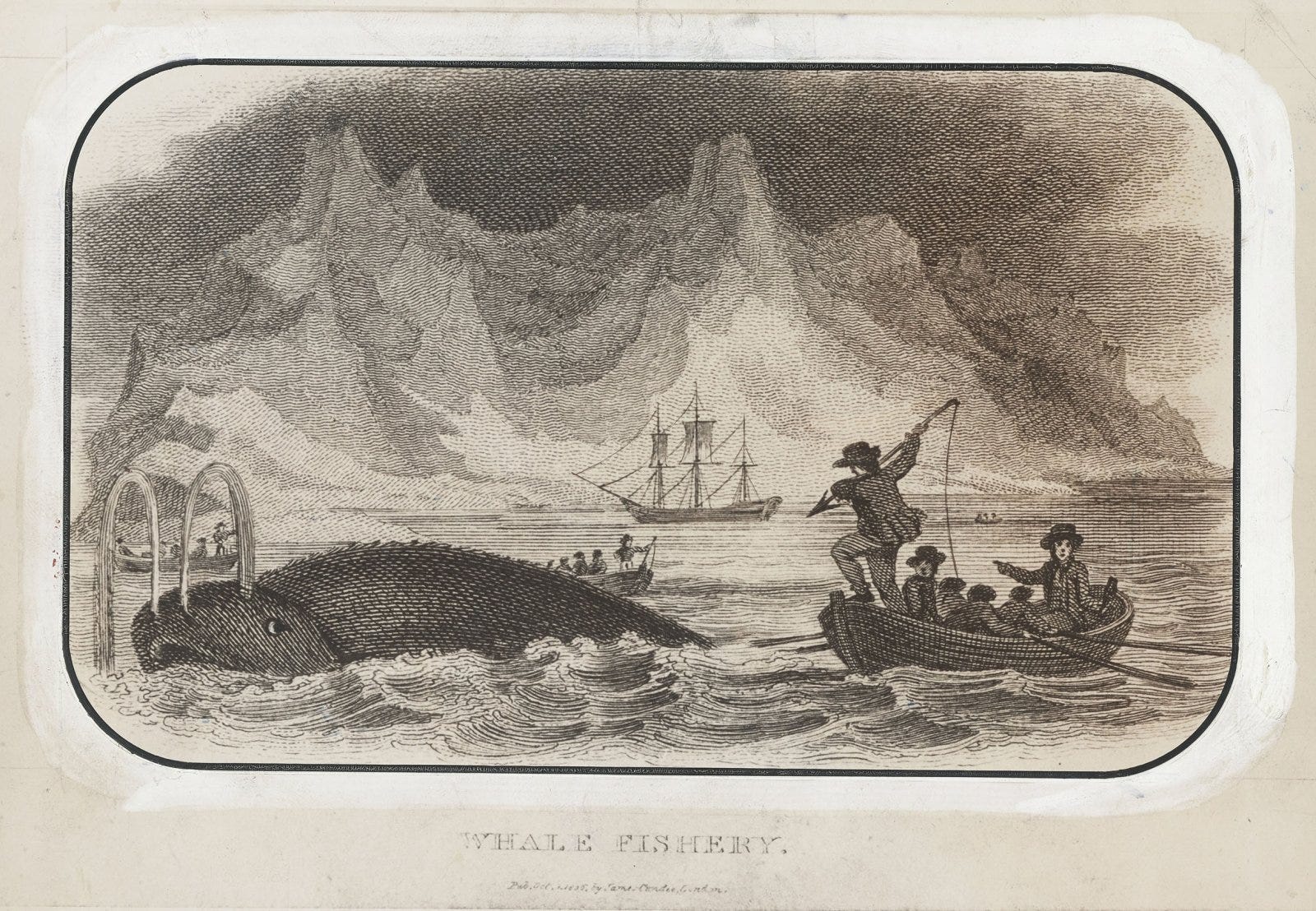
In 1846, the US owned more than 600 whaling ships, more than the rest of the world combined, and New Bedford, Massachusetts, was said to be the richest city per capita in the country (Thompson, 2012). When we think of whales, we don’t really think of the largest animals on earth as a source of energy, but that is precisely what they were. Whale oil was used to light homes and greased the machines of the early industrial age.
It was also brutal. In the last century alone, around 2.5 million whales were killed, as whalers hunted one species after another, on and on to the brink of collapse (Schneider & Pearce, 2004; Clark & Lamberson, 1982). People knew about the relentless violence and exploitation, long before the whaling industry ended. So what finally ended it?
This inquiry matters because we are facing it again with fossil fuels, another energy industry that we know is harmful, but persists because it’s profitable. Whaling’s history offers a glimpse into how transitioning could play out: the market dynamics will weaken the industry first, and politics will lock in the commitments. The comparison has limits, but the pattern is worth revisiting.
For centuries, people have hunted whales. European whalers hunted bowhead and right whales, mostly for oil and baleen. But it wasn’t until the Americans began hunting whales commercially in the 1650s that the industry took off, and by the 1830s they dominated it. Their main catch was the sperm whale, whose oil lubricated machinery and lit lamps, while baleen from other whales was used in goods such as corsets and umbrellas (National Science and Media Museum, n.d.).
The kerosene lamp offered a cheaper alternative to whale oil. Petroleum, which kerosene is refined from, went from about 2,000 barrels a year in 1859 to 2,000 barrels every 17 minutes forty years later. At the same time, whalers had killed so many whales that they became harder to find, and hunting each one grew more expensive. Whaling gradually became less profitable, while new industries offered better returns. Capital and labor naturally moved to other sectors of the economy, away from killing whales (Clark & Lamberson, 1982). Ironically, the fuel that replaced whale oil was petroleum, and in escaping one harmful energy industry we built the next.
But whaling was not over. By the 1860s, it had gained a second life, especially in Norway. Steam-powered catchers and explosive harpoons made it possible to hunt whales far more efficiently. Fast ships carried the hunt far from home waters, even to Antarctica, and whaling fleets scoured the oceans. A German hydrogenation process turned whale oil into margarine, soap and glycerine for explosives (Akamine, 2026).
The profits were enormous. In the early 1920s, most Norwegian whaling companies paid out more in dividends than in wages (Clark & Lamberson, 1982). But the damage was just as enormous.
Whalers hunted the blue whale until it grew scarce, then moved on to the fin, the sei and finally the minke, collapsing one species after another. No one stopped them because whales on the high seas belonged to no one: any fleet could take them, but the loss was shared by all, much like the atmosphere we fill with carbon today.
By the time global catches peaked at 66,026 whales in the 1961–62 season, oversupply and competition from other fats and oils were already squeezing the industry’s profits (Schneider & Pearce, 2004). Whaling nations such as the UK, Norway and the Netherlands began withdrawing their factory ships from the late 1950s onward. An econometric study by Schneider and Pearce finds that the shrinking whale population and rising incomes explain most of the decline in whaling. Regulation came after.
But economics alone did not finish the job. The 1946 International Convention for the Regulation of Whaling created the International Whaling Commission (IWC). At first, however, the commission was run largely by the whaling nations themselves, and its quotas were set too high to protect the whales it was meant to conserve (Schneider & Pearce, 2004). In 1982, the IWC adopted a moratorium on commercial whaling (WWF, n.d.). This political commitment locked in the decline and prevented further damages, such as the complete extinction of the species.
Whaling became much less powerful once cheaper substitutes appeared and better uses of capital eroded its importance. Political commitments then helped lock in the decline and stop it from ever reviving.
Today, solar and wind power are playing kerosene’s role, as cheaper alternatives that should make fossil fuels less competitive. Climate agreements such as the Paris Agreement, along with carbon pricing and coal phase-out commitments, are meant to play the IWC’s role of locking in the decline.
The comparison has obvious limitations. Whaling was never as important to the economy as fossil fuels are today, since they can determine whole national economies. Whaling’s decline partly came from a shrinking stock of whales, and fossil fuels are not running out soon enough to help. The whaling moratorium also arrived when the industry was already thinning out, which made people less resistant to it.
Even today, some nations still whale commercially. Norway and Iceland still hunt whales under formal objection, and Japan left the IWC in 2019 to continue whaling, even though Japanese whale meat consumption fell from 226,000 tonnes in 1962 to 3,000 in 2017. Substitutes also bring their own harms: the palm and soybean oils that replaced whale oil now drive biodiversity loss (Akamine, 2026).
Fossil fuels will not decline on their own, but the same combination of markets and politics is essential to a greener future: cheaper, cleaner energy, and political agreements that stop us from returning to fossil fuels.
Whaling ended only when it stopped paying, long after we knew it was wrong. With fossil fuels, we may not have the luxury to wait that long.