

Cultural, ethnic, and religious differences produce informal constraints across the Indonesian landscape. I argue that these constraints persist and exert a strong influence, shaping how formal regulations are implemented and enforced.
North (1990:37) contends that informal constraints come from socially transmitted information that was adopted as heritage. He likens such constraints to culture, providing a language-based conceptual framework to interpret information that shapes behavioural patterns.
If formal constraints are weakly enforced, informal structures will become a source of stability. North (1990:39) provides an example using Posner’s model, highlighting the impact of high information costs, weak government, trade limitations, and minimal benefits from innovation on the creation of primitive social institutions. Consequently, family ties provide a significant source of protection and a social enforcement mechanism (North 1990:39).
Indonesia’s heterogeneous landscape provides a relevant case of such structures. With 7 religions, 17,508 islands, over 1,300 ethnicities, and 700 languages, Indonesia presents a case where informal constraints vary across regions.
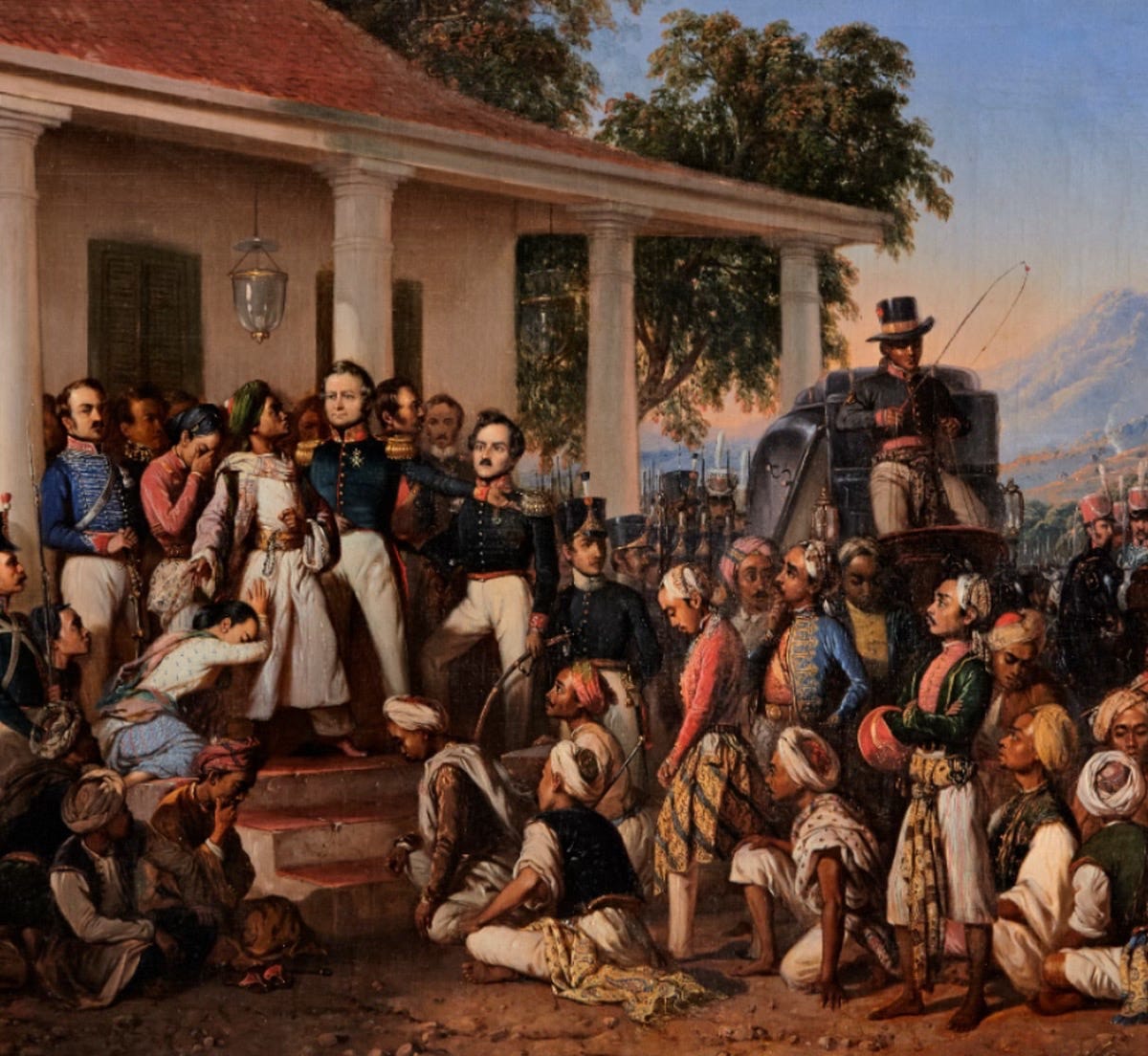
Historically, colonial rule had a long-term influence in shaping and manipulating how local cultures in Indonesia evolved. After Indonesia was colonized by the Dutch, the colonial government replaced the hierarchy of the royal bureaucratic systems across Indonesia (Hartatik 2022:67).
The structure included the priyayi, pangreh praja, patih, and wedana, local appointees of the Dutch acting as power organizers (Hartatik 2022:69). They held a strong position in society and acted as intermediaries between the colonial government and indigenous people. However, these positions were also heavily reliant on past structures of royal governance. Positions such as priyayi were previously appointed by kings through local customs (Hartatik 2022:68). Effectively, despite enforcing a new form of bureaucracy, these replacements did not completely erase the institutionalized bureaucratic culture that existed before colonialism.
The 1928 Sumpah Pemuda became a point where the idea of Indonesian unity was stated collectively on the basis of opposition to Dutch colonialism. A common political identity of the nation then emerged after a long period of pre-existing and segregated informal structures.
These informal constraints continued to have a major influence within Indonesian government and institutions after independence. Mitra and Pal (2022:970) highlight the impact of local norms on development spending, underlining a positive relationship between compliance with local norms and development spending. Their study concludes that fiscal and political decentralization is ultimately conditional on community governance and local demographics, underlining the importance of informal institutional features.
Recent cases include arguments concerning the protection of minority rights and the influence of clientelistic practices. Soedirgo (2018) underlines that state actors had shown evidence of permissive responses toward discrimination against minority groups in order to win the backing of key networks. He uses the example of the Ahmadiyah community, which had experienced a high level of discrimination.
These cases underline that formal institutions in Indonesia do not operate independently from informal constraints. Consequently, the effectiveness of formal institutions varies across regions depending on the informal structures within which they operate. Understanding Indonesian institutions therefore requires examining not only the formal rules themselves, but also the informal constraints that determine how those rules function in practice.