

Indonesia has grown at an average rate of 7% during the New Order Era and about 5% after the 1998 reform. Over this period, millions have escaped poverty and living standards have improved considerably.
But this has not translated into equal benefit for everyone. Disparities in wealth and economic opportunities remain. This raises a question: How does inequality persist despite sustained economic progress, and to what extent does Indonesia’s economic and institutional structure prolong it?

Inequality goes beyond economic outcomes. It can refer to persistent disparities in opportunities and power embedded within institutions. These inequalities are interconnected and can reproduce themselves across generations.
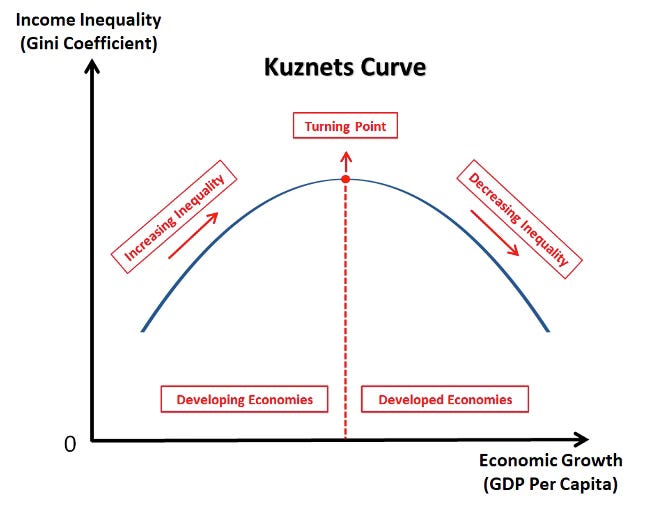
Looking at inequality through income distribution, Kuznets argued that income inequality rises as GDP per capita increases before eventually decreasing after a certain point. This produces an inverted U-shaped curve that displays a potential transition pattern between developing and developed economies.
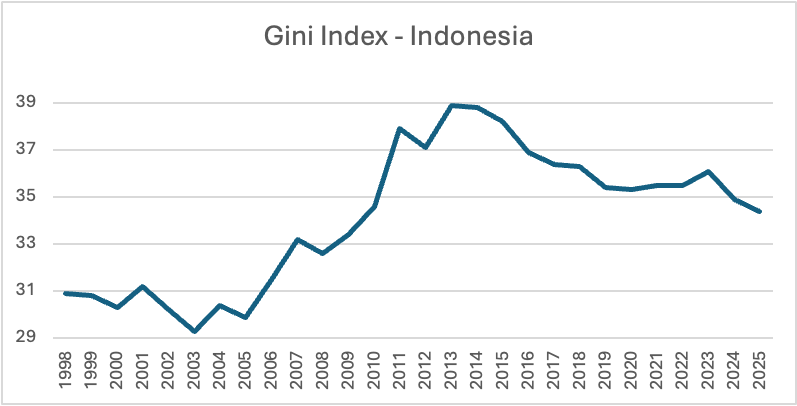
For Indonesia, particularly after the 1998 reform period, the development has superficially shown a similar pattern. Since 1998, the Gini Index had risen before reaching its peak in 2013, and has displayed a downward trajectory since then. However, this hypothesis primarily concerns expenditure distribution and does not necessarily capture larger structural inequalities in access to resources and political power.
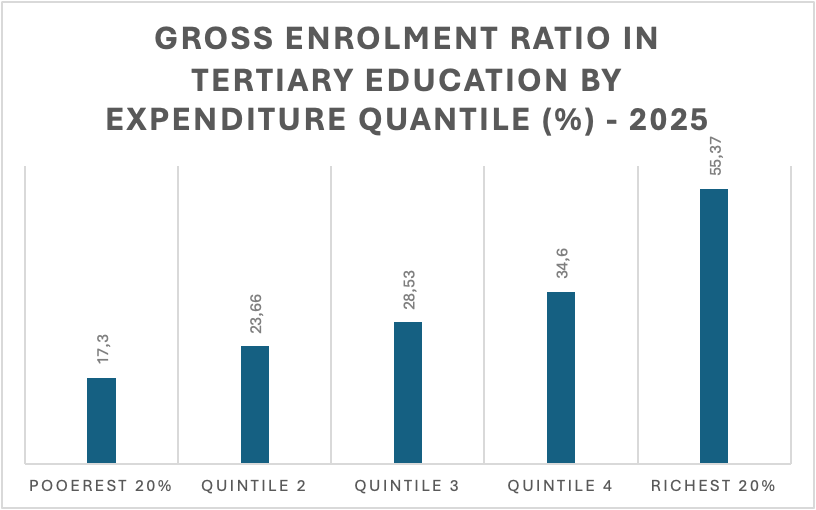
Yet, beyond consumption, the data show that disparities in access to opportunities remains. In 2025, participation in higher education is still largely shaped by household economic circumstances. Using BPS higher-education statistic, gross enrolment ratio in tertiary education reaches over 55% among the richest 20% households, compared with only 17.3% among the poorest 20%.
While if we take a look at intergenerational economic mobility, Dartanto et al. found that 9.29% of children from poorest expenditure quintile reached the richest quintile, while 35% of children from richest quintile remained there. Persistence is highest among the middle class. Education and asset ownership are shown to be the strongest determinants of mobility.
Moreover, differences in access may also extend to political representation. Studies by ICW and CSIS identify substantial business and family connections among members of parliament, raising questions about how economic and social networks shape pathways into political office. A report from Indonesian Corruption Watch (ICW) shows that 174 of 580 members of parliament for the 2024–2029 period are indicated to be affiliated with dynastic politics. CSIS highlighted a more conservative measure, indicating 138 out of 580 members are affiliated with political dynasties. ICW has also noted that at least 354 out of 580 individuals are affiliated with business sectors and can be interpreted as active CEO, directors, commissioners, founders, or shareholders.
Then, how do these inequalities persist? Galor and Zeira (1993) show that initial distribution of wealth can affect economic activity both in the short and long run. Growth is affected by the initial distribution of wealth, enabling people to invest in human capital and education, which allows advantages and disadvantages to persist. Their study underlines the importance of a large middle class for economic growth.
Acemoglu and Robinson (2008:287-288) conclude that, due to smaller numbers and greater expected gains, the elite would be likely to invest more aggressively in de facto political power. Such asymmetry has significant implications for the structure of political equilibria. They emphazise that changes in de jure power by reforms and political institutions can be entirely displaced by the influences of de facto power. Thus, paradoxically, democratic advantages could lead to greater elite political influence. This is because the presence of greater democratic advantage will increase their investment in political power. Inequality can then become self-reinforcing: unequal opportunities produce unequal resources, unequal resources produce unequal influence, and unequal influence shapes a persistent power equilibrium.
For Indonesia, reducing structural inequality requires more than only focusing on income, but addressing broader issues related to opportunities and institutional barriers that ensure political accountability. The question then, should not only on how fast Indonesia can grow, but also on how its institutions and underlying economic structure can ensure a better foundation for growth and produce more opportunities.