

Rich in Potential, Short on Capital
Indonesia has articulated its climate and energy commitments through a series of national policies and regulations governing the energy sector, most notably the renewable energy (RE) mix target, originally set at 23% by 2025 and later revised down to 17-20% as realization consistently lagged (reaching roughly 16-18% through 2025/Q1 2026). Expanding the RE mix is central to Indonesia’s broader climate commitment, as the power sector is one of the largest contributors to national emissions, making RE deployment a key pathway toward the country’s Enhanced NDC (ENDC) emission reduction targets. This target is strategically significant, as Indonesia holds abundant conventional energy resources that must be transitioned toward equally abundant renewable ones. IESR’s 2025 study estimates the economically viable technical potential of ground-mounted solar PV, onshore wind, and micro-to-mini hydro alone at 333 GW, capacity that already exceeds current RUPTL and JETP CIPP renewable targets combined (1). This potential also carries clear commercial appeal.
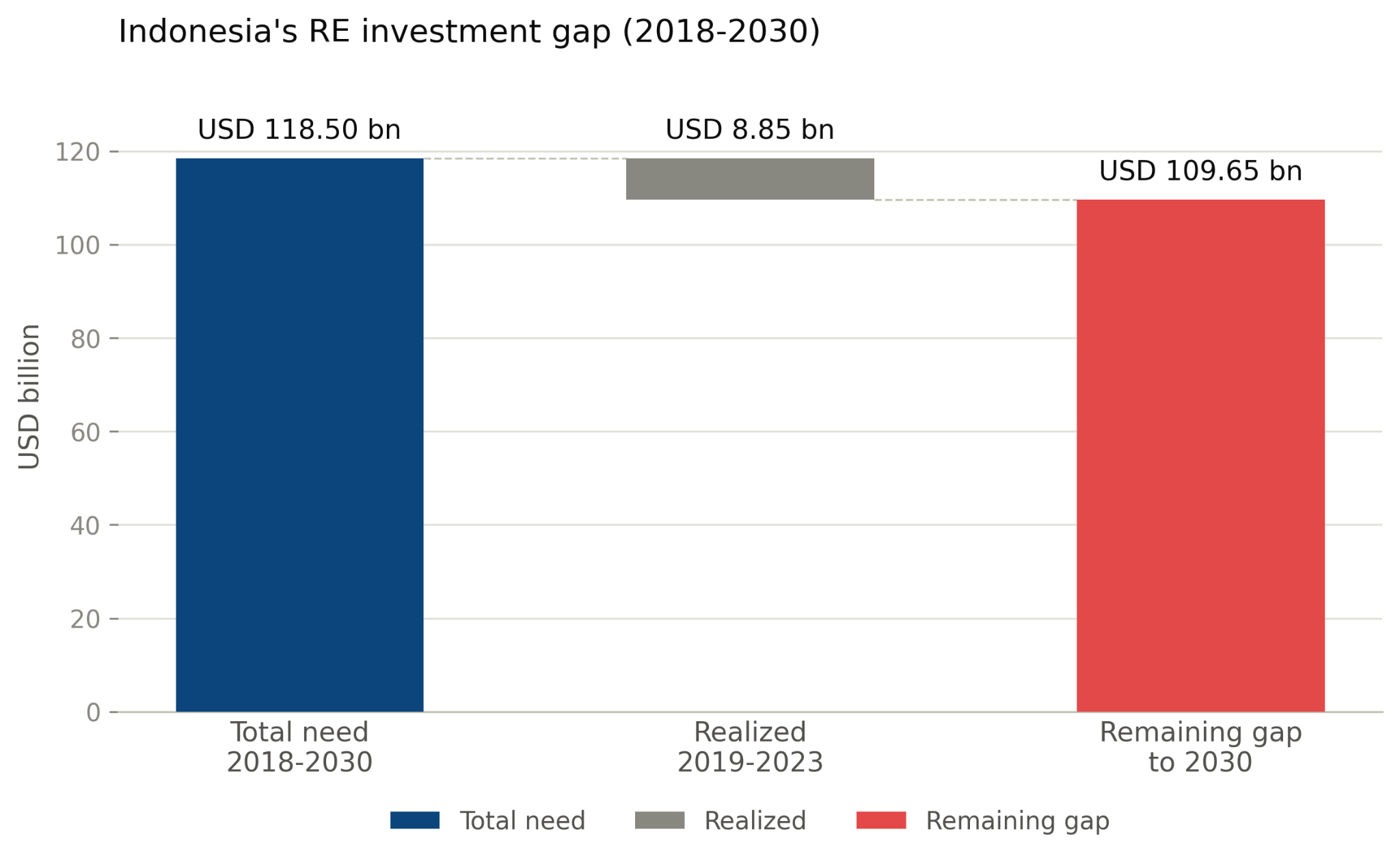
Despite this favorable outlook, financing continues to fall short. According to Climate Policy Initiative’s Indonesia Power Sector Finance Dashboard, RE investment needs between 2018 and 2030 total USD 118.5 billion, while only USD 8.85 billion was realized between 2019 and 2023, leaving a gap of USD 109.65 billion still to be mobilized through 2030. (2). This underscores that Indonesia’s binding constraint is not resource potential or bankability in principle, but the pace and structure of capital mobilization.
Indonesia RE Investment Gap to Reach 2030 ENDC Targets
Source: CPI Indonesia Power Sector Finance Dashboards, Processed
Even a Lower Bar Remains Out of Reach
Indonesia’s energy market framework continues to evolve as the government advances efforts to balance energy affordability, energy security, economic development, and the transition toward a lower-carbon energy system (3). Existing policy measures, including the coal Domestic Market Obligation (DMO) (4), and subsidies for petroleum fuels and liquefied petroleum gas (LPG), have supported energy affordability and domestic supply, while also shaping the relative competitiveness of RE (5). On the supply side, RE procurement has also faced challenges related to project implementation and procurement schedules under PLN’s Electricity Supply Business Plan (RUPTL) (6). On the demand side, the development of rooftop solar PV has been influenced by regulatory arrangements, including capacity allocation or quota mechanisms, which may affect the pace of market uptake. Together, these factors shape the current enabling environment for RE development in Indonesia, and even after the target was revised down, actual RE deployment has remained below it (7).
Certainty and Transparency, What Capital Is Looking For
A credible and sustainable commitment to reducing fossil fuel reliance is therefore critical. Consistent energy transition targets, maintained without frequent revision and supported by demonstrated implementation, would significantly improve investor confidence in RE. Although the transition may increase electricity and fuel prices in the short term, particularly where fossil fuels remain cheaper than RE due to policy distortions (8), it would narrow the price gap between fossil fuels and RE, thereby strengthening demand for RE and catalyzing further investment. Reallocating fossil fuel subsidies toward RE would reinforce this shift, driving both deployment and private investment for RE.
Greater transparency would improve certainty and predictability, enabling developers to prepare higher-quality proposals and attract investor interest. PLN’s RUPTL already provides a substantial foundation, outlining renewable energy capacity targets and project pipelines through 2034. What remains is translating this plan into a clear, consistently updated procurement calendar, maintained by PLN or the Ministry of Energy and Mineral Resources (MEMR), with implementation progress updated regularly. Procurement progress should be disclosed through a publicly accessible online portal that lists projects, provides regular procurement schedules similar to those implemented in India (9), and the disclosure of project developers, accompanied by detailed project planning proposals comparable to Indonesia’s National Registry System for carbon projects (10).
References
1. IESR. Unlocking Indonesia’s Renewables Future: the Economic Case of 333 GW of Solar, Wind and Hydro Projects. s.l. : Institute for Essential Services Reform (IESR), 2025.
2. CPI. Indonesia Power Sector Finance Dashboard. 2025. https://www.climatepolicyinitiative.org/press-release/cpi-launches-indonesia-power-sector-finance-dashboard-2019-2023-reveals-growing-investments-in-variable-re-and-opportunities-to-close-investment-gap/
3. Simajuntak, Uliyasi and Hasjanah, Kurniawati. IESR. [Online] Institute for Essential Services Reform (IESR), October 2025. https://iesr.or.id/en/overcoming-energy-transition-barriers-with-renewable-energy-procurement-process-reform/.
4. Muliawati, Firda Dwi. Prices Cause Disquiet, Perhapi: Entrepreneurs Must Comply with the Coal DMO. CNBC Indonesia. [Online] CNBC Indonesia, 2024.https://www.cnbcindonesia.com/news/20240828172933-4-567207/harga-bikin-galau-perhapi-pengusaha-harus-patuhi-dmo-batu-bara.
5. Syaharani, Mela. Subsidi BBM, LPG dan Listrik RI Tembus Rp 159,6 Triliun di 2023.Katadata.co.id. [Online] Katadata.https://katadata.co.id/berita/energi/65a5f094101d6/subsidi-bbm-lpg-dan-listrik-ri-tembus-rp-159-6-triliun-di-2023.
6. The country of perpetual potential: Why is it so difficult to procure renewable energy in Indonesia? Halimatussadiah, Alin, et al. s.l. : Renewable and Sustainable Energy Reviews,2024, Vol. 201.
7. Yustika, Mutya. The Dark Cloud Over Indonesia’s Pledge to Achieve Net-zero Emissions by 2060. [Online] Institute for Energy Economics and Financial Analysis, 2024. https://ieefa.org/resources/dark-cloud-over-indonesias-pledge-achieve-net-zero-emissions-2060
8. Institute for Essential Services Reform (IESR). Without Subsidies, Which is Cheaper, Coal-fired Power Plants or Renewable Energy? [Online] IESR, 2024. https://iesr.or.id/en/without-subsidies-which-is-cheaper-coal-fired-power-plants-or-renewable-energy/.
9. Sharma, Prabhakar, Srivastava, Ashita and Mehra, Deepalika. Challenges in India’s Tender-Driven Renewable Energy Market. [Online] 2024. https://ieefa.org/sites/default/files/2025-03/Challenges%20in%20India%E2%80%99s%20Tender-Driven%20Renewable%20Energy%20Market_March%202025.pdf.
10. Ministry of Environment and Forestry Indonesia. Sistem Registri Nasional Perubahan Iklim. [Online] Ministry of Environment and Forestry Indonesia, 2026. https://srn.kemenlh.go.id/index.php?r=home%2Findex.