

Amid the extensive efforts of green transition worldwide, most countries face significant costs and adjustments along the transition. The effects of these efforts are more pronounced in emerging markets and developing countries (EMDEs) where they face elevated debt vulnerabilities and financing needs (IMF, 2025). However, these countries do not have a choice as many scholars argue that the long-term environmental, economic, and social benefits outweigh the challenges.
The challenge is therefore not simply whether the green transition is desirable, but how it can be financed without undermining debt sustainability, essential public services, or social welfare.
The dilemma takes different forms across countries. Indonesia and South Africa must reduce their dependence on coal while managing risks to government revenue, employment, and energy security (Gomes, 2026; Mustasya, 2026). Nigeria illustrates the political and fiscal difficulty of removing fossil-fuel subsidies: reform can create space for other public spending, but it can also raise transport and living costs (Osho et al., 2026). Bangladesh must divide scarce resources between immediate climate-adaptation needs, such as flood protection and disaster recovery, and longer-term investment in clean energy (Nandi et al., 2025). Meanwhile, countries such as Zambia and Vietnam require substantial financing for renewable generation and electricity infrastructure but remain constrained by limited fiscal space and high borrowing costs.
These examples show that the green transition in EMDEs is not only an environmental challenge. It is also a fiscal balancing act between climate objectives, economic development, debt sustainability, and social welfare.
The Pigouvian rationale
Pollution is a negative externality because firms and consumers do not bear the full social costs of the emissions they produce. Carbon pricing, subsidy reform, environmental regulation, and public investment can help internalize these costs by aligning private incentives more closely with social welfare (Pigou, 1920).
However, policies that improve long-term welfare can still create short-term fiscal and distributional pressures. A coal phase-out may reduce royalties, taxes, and profits from fossil-fuel-related activities. A carbon tax may initially generate public revenue, but that revenue can decline over time as emissions fall. Governments may also need to finance clean infrastructure, support affected workers and regions, and protect vulnerable households from higher energy costs.
The result is a genuine fiscal dilemma. Governments must manage the long-term gains from lower emissions while meeting immediate budget constraints and maintaining public support. This preserves the core logic of the original Pigouvian section without treating carbon taxation as an immediate loss of government revenue.
Multiple dimensions of dilemma
Utilizing a Cons-Pros framework clarifies the exact dilemmas faced by EMDEs. This approach evaluates whether the social benefits of a policy or project justify its economic costs, especially when navigating trade-offs with highly scarce resources. It is widely applicable to critical decision-making areas, including infrastructure investment (Thoft-Christensen, 2012), public health initiatives (Brent, 2014), and urban transportation networks (Mouter et al., 2021). The Cons-Pros of this study is illustrated below
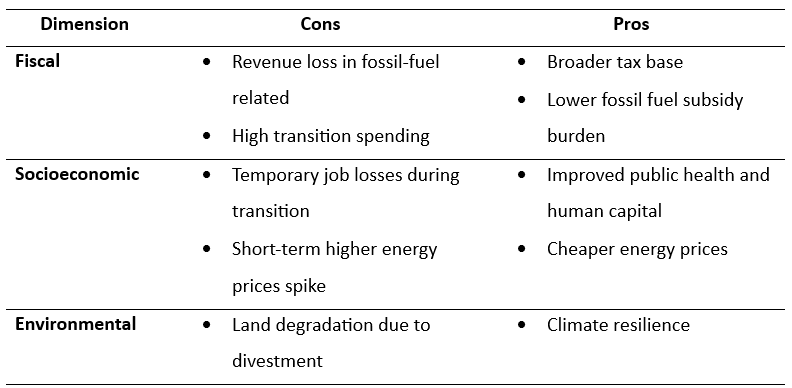
The first strand explains the fiscal dimension of green transition. Cons aspects are quite straightforward, where government face a revenue loss from the fossil fuel (Hansen, 2022), especially where government benefits a huge tax revenue from the fuel excise. High transition spending matters. Shifting from the brown into green economy requires such a huge investment, especially where green technology requires high capital intensity (OECD, 2024). This will be enclosed by the investment loss if the government fails to utilize this high investment (Nawaz & Su, 2026). The riskiness is associated with high uncertainty due to rapid technological disruption, underdeveloped government policies, and steep learning curve of new technology. However, even though we are faced with these issues, benefit aspects reveal the potential such as broader tax base in green economy by shifting the fiscal burden away from brown economy such as fuel excise, into congestion taxes, carbon pricing, and broad-based environmental levies ensures stable revenue to fund climate infrastructure without overburdening working-class taxpayers. This creates stable, long-term public revenue while simultaneously pricing negative externalities. Last but not least, successful implementation of green transition attracts investors, which is translated into job vacancies (Gasparini et al., 2025).
The socioeconomics aspects are explained in the second strand. High transition costs are not limited to direct monetary expenditures but also include the opportunity costs associated with temporary employment losses. Businesses, workers, and infrastructure require time to adjust before the transition can be fully implemented (Emmerling et al., 2025). This further exacerbates the economic impact by causing a sharp increase in energy prices, as consumers and businesses have long relied on fossil fuel subsidies (Belgioioso & Newman, 2025). However, these costs are likely to be offset by improved public health outcomes, as lower pollution levels reduce the incidence of pollution-related illnesses (Li et al., 2023), which also indirectly translated into better human capital quality. In the long term, energy prices are also likely to become more stable and affordable, as renewable energy sources are less exposed to fluctuations in global commodity prices than fossil fuels (Hedley, 2025).
The final strand considers the environmental dimension. Transitioning to a green economy requires the development of new land and infrastructure. At the same time, divestment from the brown economy leaves a permanent environmental “scar” (Baron & Fischer, 2015). For example, quarrying and hydraulic fracturing can cause long-lasting damage to land, regardless of whether governments subsequently transition to a green economy. Nevertheless, this transition also offers significant environmental benefits by enhancing climate resilience and reducing dependence on environmentally harmful resources (UNDP, 2025)
Concluding remarks
All in all, the green transition presents EMDEs with a difficult fiscal balancing act. While the Pigouvian framework justifies government intervention to correct environmental externalities, limited fiscal space, debt constraints, and competing development priorities make implementation challenging. The analysis shows that green transition not only affects fiscal dimension, but rather has socioeconomic and environmental consequences. Successful green transition policies require careful policy design, sound fiscal management, and adequate financing to ensure that long-term sustainability is achieved without compromising economic development and social welfare.
References
Baron, R., & Fischer, D. (2015). Divestment and Stranded Assets in the Low-carbon Transition. OECD. https://doi.org/https://web-archive-storage.oecd.org/aemint-web-archive-prod/web-archive/c7/c7284e886513437a74e2d949ba8dc4e3ce497e626639e80eb68c81a2ccfc3f20.pdf
Belgioioso, M., & Newman, E. (2025). Fossil fuel subsidy reform, distributive justice and civil unrest. Energy Research & Social Science, 119, 103868. https://doi.org/10.1016/j.erss.2024.103868
Brent, R. J. (2014). Cost–Benefit Analysis and Health Care Evaluations, Second Edition. Edward Elgar Publishing. https://doi.org/10.4337/9781781004593
Briggs, C., Atherton, A., Gill, J., Langdon, R., Rutovitz, J., & Nagrath, K. (2022). Building a ‘Fair and Fast’ energy transition? Renewable energy employment, skill shortages and social licence in regional areas. Renewable and Sustainable Energy Transition, 2, 100039. https://doi.org/10.1016/j.rset.2022.100039
Emmerling, J., Drouet, L., Jewell, J., Nacke, L., Pai, S., & Zerriffi, H. (2025). Green jobs and just transition: Employment implications of Europe’s Net Zero pathway. Energy Research & Social Science, 127, 104292. https://doi.org/10.1016/j.erss.2025.104292
Garg, V. (2024). Union Budget should set the tone to accelerate clean energy. Institute for Energy Economics and Financial Analysis. https://doi.org/https://ieefa.org/resources/union-budget-should-set-tone-accelerate-clean-energy
Gasparini, D., Bakens, J., Mulder, P., & Pestel, N. (2025). How green are jobs for the energy transition? Energy Research & Social Science, 129, 104368. https://doi.org/10.1016/j.erss.2025.104368
Gomes, C. (2026). Clean coal technologies as transitional buffers in South Africa’s just energy transition: Safeguarding livelihood amid decarbonisation. Scientific African, 31, e03210. https://doi.org/10.1016/j.sciaf.2026.e03210
Hanafy, S. A., Abouelenein, M. F., Roushdy, N., Ibrahiem, D. M., Addai, G., Sethi, N., Esily, R. R., & Samah, R. (2025). Key factors in environmental quality: Green finance, energy and trade. Energy Strategy Reviews, 60, 101800. https://doi.org/10.1016/j.esr.2025.101800
Hansen, T. A. (2022). Stranded assets and reduced profits: Analyzing the economic underpinnings of the fossil fuel industry’s resistance to climate stabilization. Renewable and Sustainable Energy Reviews, 158, 112144. https://doi.org/10.1016/j.rser.2022.112144
Hedley, N. (2025). The myth of renewables pushing up power prices [Working Paper]. Zero Carbon Analytics. https://doi.org/https://zerocarbon-analytics.org/energy/the-myth-of-renewables-pushing-up-power-prices/
IMF. (2025). Debt Vulnerabilities And Financing Challenges In Emerging Markets And Developing Economies—An Overview Of Key Data. Policy Papers, 2025(002), 1. https://doi.org/10.5089/9798229002264.007
Li, M., Geng, Y., Zhou, S., & Sarkis, J. (2023). Clean energy transitions and health. Heliyon, 9(11), e21250. https://doi.org/10.1016/j.heliyon.2023.e21250
Marcel Nuta, F., Joseph Abban, O., & Cristina Nuta, A. (2025). Green finance’s role for sustainable development in the context of COP targets. Sustainable Energy Technologies and Assessments, 82, 104501. https://doi.org/10.1016/j.seta.2025.104501
Mouter, N., Koster, P., & Dekker, T. (2021). Contrasting the recommendations of participatory value evaluation and cost-benefit analysis in the context of urban mobility investments. Transportation Research Part A: Policy and Practice, 144, 54–73. https://doi.org/10.1016/j.tra.2020.12.008
Mustasya, T. (2026). Ending Indonesia’s Coal Export Duty Exemption: A necessary policy reform for a just energy transition [Commentary]. Just Energy Transition in Coal Regions: Knowledge Hub. https://doi.org/https://www.jetknowledge.org/insights/ending-indonesia-coal-export-duty-exemption-a-necessary-policy-reform-just-energy-transition/
Nandi, R., Shahrin, S., Kabir, W., & Krupnik, T. J. (2025). Advancing climate adaptation and mitigation in Bangladesh: Strengthening policy, institutions, and finance for resilient development. CGIAR. https://doi.org/https://hdl.handle.net/10568/180894
Nawaz, A., & Su, C. W. (2026). Is ESG uncertainty undermining green investment along the global financial path to sustainable development? Economic Analysis and Policy, 91, 192–205. https://doi.org/10.1016/j.eap.2026.03.014
OECD. (2024). Bridging the clean energy investment gap: Cost of capital in the transition to net-zero emissions (OECD Environment Working Papers No. 245; OECD Environment Working Papers, Vol. 245). https://doi.org/10.1787/1ae47659-en
Osho, A. J., Nwosu, C. E., Meshioye, M. O., & Nwosu, A. G. (2026). Assessing the firm-level costs of fuel subsidy removal: A study on the viability and adaptive strategies of Nigerian micro, small and medium enterprises. Cogent Business & Management, 13(1), 2676338. https://doi.org/10.1080/23311975.2026.2676338
Pigou, A. C. (1921). The Economics of Welfare. The Economic Journal, 31(122), 206. https://doi.org/10.2307/2222816
Thoft-Christensen, P. (2012). Infrastructures and life-cycle cost-benefit analysis. Structure and Infrastructure Engineering, 8(5), 507–516. https://doi.org/10.1080/15732479.2010.539070
UNDP. (2025). What is the sustainable energy transition and why is it key to tackling climate change? Climate Promise. https://doi.org/https://climatepromise.undp.org/news-and-stories/what-sustainable-energy-transition-and-why-it-key-tackling-climate-change
World Bank. (2025). Viet Nam and the Sustainable Finance Facility. World Bank News. https://doi.org/https://www.worldbank.org/en/news/feature/2025/06/26/viet-nam-and-the-sustainable-finance-facility
Zambian Ministry of Finance and National Planning. (2026). Zambia initiates a landmark debt-for-energy conversion with the support of the African Development Bank. MoFNP News. https://doi.org/https://www.mofnp.gov.zm/?p=8632
